Starting a Business in Canada Checklist: Registration, BN, GST/HST, Permits and First 90 Days
Use this practical starting a business in Canada checklist to choose a structure, complete business registration, get a Business Number, handle GST/HST, check permits, and plan your first 90 days.
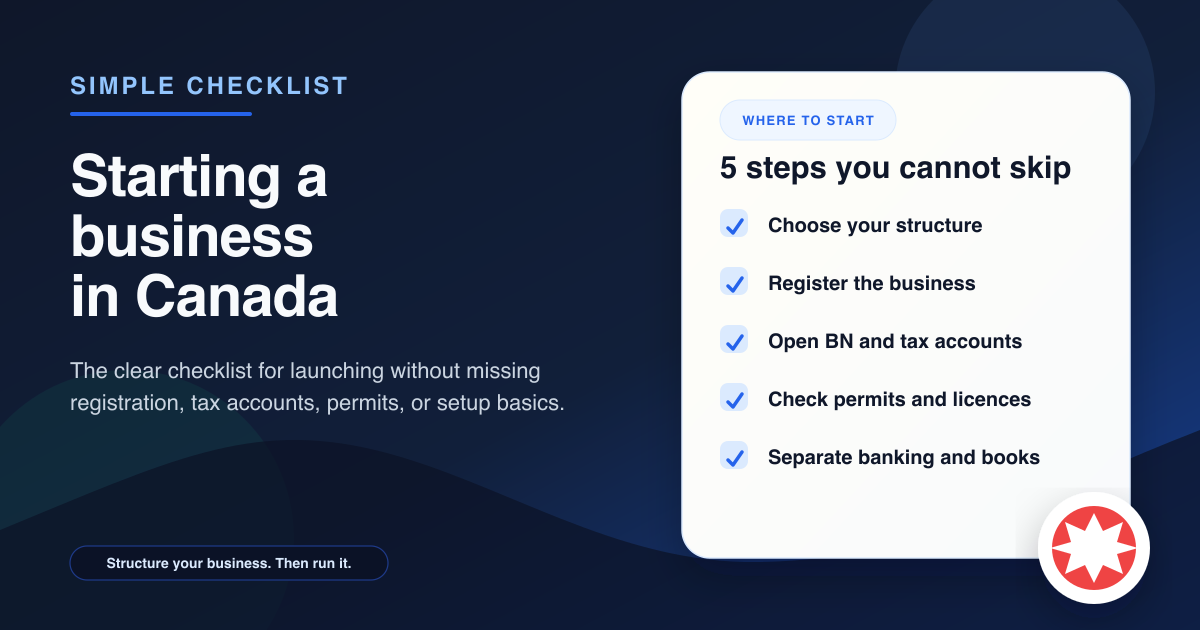
Starting a Business in Canada: Checklist for Registration, Taxes and Your First 90 Days
Most guides about starting a business in Canada tell you many correct things in an unhelpful order. You get a blur of naming, incorporation, licences, taxes, banking, websites, and marketing.
In practice, the order matters as much as the list.
So this article is built as an execution checklist. First, what to validate before you spend. Then structure, registration, CRA accounts, permits, your minimum setup to get paid, and the first 90 days.
Important: this article is Canada-first, not province-blind. Business registration, provincial sales tax, workers' compensation, sector-specific licensing, and extra-provincial registration rules can vary by province, territory, and sometimes municipality. Always confirm your exact case before acting.
Before You Spend Money to Start a Business in Canada
This is the section generic checklists usually rush through. It is also where you avoid the most expensive beginner mistakes.
- Describe your offer in one plain sentence. Not your 10-year vision. What you sell, to whom, and what problem it solves now.
- Name your first customer segment precisely. "Small businesses" is too broad. "Private clinics with 1 to 5 staff in Toronto" is a real starting segment.
- Validate real demand. Talk to potential buyers. Get replies, calls, deposits, signed quotes, waitlists, or pilot interest. Encouragement is not validation.
- Choose a test price. Many businesses do not fail because the idea was bad, but because the price never covered the real cost of delivering.
- Calculate your 90-day survival number. How much cash do you need for the first three months including software, rent, phone, travel, taxes, insurance, and mistakes?
- Decide where the business will actually operate. Home-based, online, on client premises, in a studio, in a storefront? That answer changes permits, insurance, and sometimes registration.
- List your legal and tax triggers. Partner, lease, staff, inventory, importing, debt, regulated activity, or commercial space.
If you cannot check these boxes yet, do not spend heavily on branding. You need clarity before you need polish.
That is also where TowerZ can help you structure the first steps before you start paying for the wrong things.
Try TowerZ for free
Structure your first steps, clarify your priorities, and start building the business in one place.
Starting a Business in Canada Checklist: 10 Steps
1. Choose the right business structure in Canada
The three most common starting points in Canada are:
- Sole proprietorship
- Partnership
- Corporation
The useful question is not: which one looks more serious? The useful question is: which structure fits the actual risk, complexity, ownership, and stage of the business?
If you are thinking about incorporation, read our guide on what limited liability actually protects, and what it doesn't. Incorporation can be the right move, but it does not replace tax discipline, insurance, or clear contracts.
Limited Liability: What Incorporation Actually Protects, and What It Doesn't
Incorporation limits certain risks, but it doesn't make you untouchable. The nuances every Quebec/Canada entrepreneur should understand before and after incorporating.
Action checklist
- Choose between sole proprietorship, partnership, or corporation.
- If you are incorporating, decide whether you are incorporating provincially or federally.
- If there is more than one founder, define ownership, decision-making, signing authority, and exit rules early.
2. Check provincial and municipal business registration rules first
One of the most common mistakes is assuming that "starting a business in Canada" means there is one single administrative path. There is not.
Depending on where you operate, the rules may differ on:
- sole proprietorship or business name registration;
- name availability and naming rules;
- provincial sales tax requirements;
- payroll and workers' compensation obligations;
- professional or sector-specific licensing;
- extra-provincial registration if you operate across jurisdictions;
- municipal rules, especially if you run the business from home.
For permits and licences, start with BizPaL. It is often the fastest way to get a location-specific, activity-specific list.
Action checklist
- Check your province or territory before finalizing the structure.
- Check your municipality if you are operating from home or from a physical space.
- Confirm whether your activity is regulated even if it seems straightforward.
3. Choose a business name you can register and use
The best name is not just a good domain. It also has to work with your structure, your province, and, if you incorporate, your naming obligations.
If you are incorporating federally, Corporations Canada lays out the process and highlights an important point: a federal corporation also needs to be registered in a province or territory.
Keep the name simple. Launching does not require genius branding. It requires a usable, clear, searchable name.
Action checklist
- Check the name in the relevant registry before committing to it.
- Secure the domain and key handles if they matter to your launch.
- If you are incorporating, confirm naming rules before having documents prepared.
4. Register your business or incorporate at the right time
Once you know the structure, complete the right registration.
If you are incorporating federally, use the official Corporations Canada incorporation guide. If you are staying as a sole proprietor or partnership, follow your province or territory's registration process.
The practical rule here is simple: do not wait too long once you are actively selling, but also do not rush into a heavier structure only to feel more official.
Action checklist
- File the registration or incorporation through the correct registry.
- Save every confirmation number, certificate, and filing record.
- If you incorporated federally, verify the next provincial or territorial registration step immediately.
5. Get your Business Number and the right CRA accounts
For most Canadian businesses, the administrative core is the Business Number (BN) plus the relevant CRA program accounts.
The CRA explains how to register as a resident with a Canadian business and how to open program accounts such as:
- GST/HST
- payroll deductions
- corporation income tax
- other accounts if your business model requires them
One practical detail that beginners often miss: depending on how you registered or incorporated, you may already have a BN. Check your records before creating duplicates.
GST/HST registration: know when the $30,000 threshold applies
For most businesses, the CRA says you generally become required to register when you exceed the $30,000 small supplier threshold under the applicable rules. The official breakdown is here: When to register for and start charging the GST/HST.
That does not mean you should ignore sales tax until the moment it becomes urgent. Track your revenue from the beginning. And if you operate in Quebec or in a jurisdiction with separate provincial sales tax rules, confirm those obligations separately.
Action checklist
- Get a BN if your situation requires one.
- Open only the CRA program accounts you actually need.
- Check from day one whether GST/HST registration is required or whether voluntary registration makes sense.
- If you will hire employees, open payroll before the first payroll run.
6. Open a business bank account and bookkeeping system early
Mixing personal and business money is one of the fastest ways to make your business harder to understand, harder to tax properly, and harder to grow.
Even as a sole proprietor, separating the money makes it much easier to:
- track what is coming in and going out;
- see your real margin;
- prepare your tax filing;
- answer your accountant's questions;
- stop mistaking cash movement for profit.
Action checklist
- Open a separate business banking setup, or at minimum a rigorously separate operating flow.
- Choose a simple bookkeeping system.
- Decide how revenue, reimbursements, expenses, and taxes will be categorized.
- Keep receipts and source documents from day one.
7. Set up tax discipline before revenue grows
Many new businesses do not collapse because they were not selling. They collapse because the money they collected was never really available to spend.
The right habits start early:
- set aside sales tax collected;
- plan for income tax or corporate tax;
- track deductible expenses properly;
- stop treating the bank balance like pure profit.
The CRA's Checklist for small businesses is a solid tax starting point. If you operate in Quebec, our GST/QST invoice guide for service businesses may also help.
Action checklist
- Decide what share of incoming cash you will set aside for taxes.
- Standardize your invoice format and numbering.
- Pick your bookkeeping review rhythm: weekly, biweekly, or monthly.
8. Cover the basic risks: insurance, contracts, partners and data
Even before growth, the risk is already real:
- a client disputes an invoice;
- a partner changes direction;
- client data is handled poorly;
- damage happens in your space or at a client site;
- a verbal agreement turns out to mean different things to different people.
You do not need maximum complexity on day one. You do need a clean minimum.
Action checklist
- Check the insurance types relevant to your sector.
- Use clear contracts or terms, even if you are starting small.
- If you have co-founders, document ownership, roles, exits, and decisions.
- If you collect client data, secure access, passwords, and storage at a basic professional level.
9. Build the minimum system to sell and get paid
Before you think "software stack," think minimum revenue path:
- someone finds you;
- they understand the offer;
- they contact you or book;
- they pay or approve a quote;
- they receive an invoice or receipt;
- they receive follow-up.
If that path does not exist, the business is not ready, no matter how nice the website looks.
Action checklist
- Build a simple page that explains the offer, who it is for, and what the next step is.
- Set up a clear contact, quote, or booking path.
- Choose a payment method your clients will actually use.
- Make sure a post-sale follow-up exists.
10. Plan the first 90 days of your business
Starting a business is not a moment. It is a period.
You need a short, usable 90-day plan with:
- a revenue target;
- a sales target or project target;
- a maximum expense line;
- weekly business development activity;
- one number you absolutely watch;
- one review point every month.
For the strategy side, see our guide on how to write a business plan for a service business, our article on financial forecasts, and our guide on pricing services.
How to Write a Business Plan for a Service Business
A practical, no-fluff business plan template for service entrepreneurs. What to include, what to skip, and how to keep it useful past week one.
Action checklist
- Set a 90-day revenue target.
- Set a 90-day expense cap.
- Choose 1 to 3 acquisition channels, not 8.
- Put a month-end review in your calendar now.
What Most Business Startup Checklists in Canada Miss
Competing guides usually cover the same basic building blocks: plan, structure, registration, banking, tax, website. The problem is not the list. The problem is that they are often not explicit enough about what to do before spending, what changes by province, and what has to exist after the launch so the business survives.
What actually makes a difference early:
- do not incorporate just to feel serious;
- do not overbuy software before demand exists;
- do not mix personal and business money;
- do not ignore sales tax until it hurts;
- do not launch without a minimum follow-up system.
FAQ: Starting a Business in Canada
Do I need to incorporate before landing my first client? Not necessarily. Many businesses start in a simpler structure. Incorporation becomes more relevant when risk, tax planning, ownership, growth, or financing make it worth it.
Do I need a Business Number right away? Not always. It depends on your structure and which CRA program accounts you need. Check the CRA path that applies to your situation before assuming.
When do I have to charge GST/HST? For most businesses, CRA rules revolve around the $30,000 small supplier threshold and how you exceed it. Always confirm the official details before you start charging.
Can I run the business from home? Often yes, but it depends on the activity, your municipality, your lease if you have one, your insurance, and sometimes permit requirements.
Federal or provincial incorporation: which is better? That depends on your operating footprint, name strategy, and plans. A federal corporation still needs provincial or territorial registration.
Official Resources for Starting a Business in Canada
- CRA: Checklist for small businesses
- CRA: Register as a resident with a Canadian business
- CRA: When to register for and start charging the GST/HST
- BizPaL: permits and licences search
- Corporations Canada: how to incorporate a business
- BDC: start a business in Canada checklist
Start the Business Right, Then Run It
The hardest part of starting a business is not just checking administrative boxes. It is keeping the thread between structure, planning, sales, and actual operations.
That is where TowerZ can help. It gives you a place to structure the business, clarify the plan, pressure-test your assumptions, and keep that thinking connected to execution instead of losing it inside a static document.
If you want to move from a static checklist to a more living system, explore Business Analysis or try TowerZ.
This article is for informational purposes only and is not legal, tax, or accounting advice. For decisions on structure, tax, or compliance, confirm your situation with a qualified professional and the official sources that apply in your province or territory.

About Orléando Dassi
Chief Executive Officer & Co-Founder
Orléando leads product vision, business strategy, and the long-term direction behind Automathing Group Inc. and TowerZ. He combines 12+ years in IT with a bachelor's degree in software development, business launch (ASP) training, and an MBA in progress at Université de Sherbrooke.
Related articles
Vision, Mission, and Values: Examples That Actually Mean Something
A practical guide to writing a vision, mission, and core values your team can actually use, with real examples across different kinds of businesses and a 60-second AI generator inside TowerZ.
How to Price Your Services (2026 Pricing Strategy Guide)
How to price your services without guessing. A practical method for salons, coaches, clinics, and studios, with a TowerZ-ready dashboard.
How to Write a Business Plan for a Service Business (2026)
A practical, no-fluff business plan template for service entrepreneurs. What to include, what to skip, and how to keep it useful past week one.