Limited Liability: What Incorporation Actually Protects, and What It Doesn't
Incorporation limits certain risks, but it doesn't make you untouchable. The nuances every Quebec/Canada entrepreneur should understand before and after incorporating.
Limited Liability: What Incorporation Actually Protects, and What It Doesn't
If you have ever talked about incorporation with another entrepreneur, you have probably heard this line: "incorporate yourself, that way your personal assets are protected."
It is not wrong. It is just very incomplete.
Incorporation creates a separate legal person from you. That is a real legal protection, and for many entrepreneurs, the decision to incorporate is worth it. But it does not turn you into an untouchable ghost. There are at least five common situations where your personal assets remain exposed, despite incorporation.
This article is not legal advice. Its purpose is to help you ask better questions to your lawyer, your accountant, and your advisor, so you can structure your business with eyes open.
What Incorporation Actually Does
In Quebec, a corporation (société par actions) is a legal person distinct from its shareholders. Shareholders normally have liability limited to the value of their shares. If the corporation is sued, the corporation pays, not the shareholders personally. That is the foundation of the model, and that is what makes incorporation useful.
But there is a crucial detail that Éducaloi (the public legal education organization) is careful to highlight: in most small and medium businesses, shareholders are also directors. And director liability is very different, much broader, and often personal. The illusion of complete invincibility takes root in the confusion between those two roles.
Here are the five nuances every Quebec/Canada entrepreneur should understand.
1. You Are Protected as a Shareholder, Not Automatically as a Director
This is the most common confusion among solo entrepreneurs.
When you incorporate a business and you are the sole shareholder and sole director, you wear two hats that look identical but are legally very different.
As a shareholder, your risk is limited to the value of your shares. As a director, you make decisions in the corporation's name, and the law holds you personally responsible for several obligations. You can be sued personally, in civil and sometimes criminal proceedings, for failures in your duties as a director.
Directors have duties of prudence, diligence, honesty, and loyalty toward the corporation. A serious fault, a reckless decision, or a failure to comply with a legal duty can lead to personal liability, even though the corporation is incorporated.
In practical terms, "I'm incorporated, so I'm protected" is wrong. More accurate: "I'm incorporated, so my personal assets are shielded from the corporation's ordinary commercial debts, except in cases where the law holds me personally responsible anyway."
2. Tax Debts and Government Remittances Can Catch Up to You
This is the most underestimated exposure.
The Canada Revenue Agency is explicit: directors can be held personally liable if the corporation fails to deduct, withhold, remit, or pay certain required amounts. That includes:
- Source deductions (income tax, CPP/QPP, EI) withheld from employee wages
- GST and QST collected on sales
- Certain mandatory contributions and premiums
The tax authorities' logic is simple: these amounts are not the corporation's money, they are amounts the corporation collects or withholds on behalf of the government. If they are not remitted, the director can be required to pay personally, with interest and penalties.
Incorporation does not shield you from this. A corporation that goes bankrupt with unpaid taxes typically leaves its directors with a personal tax debt that follows them for years.
For a solo entrepreneur who is also the sole director of their own corporation, this is exactly the kind of surprise that would have been less unpleasant if it had been explained from the start.
3. The Corporate Veil Can Be Pierced in Certain Cases
Article 317 of the Civil Code of Quebec is short but important. It provides that a legal person's juridical personality cannot be invoked to mask fraud, abuse of right, or contravention of a rule of public order.
In practice, that means a court can "pierce the corporate veil" and hold the shareholder or director personally liable if the corporation has been used to:
- Conceal fraud
- Unlawfully circumvent an obligation
- Divert funds to personal assets
- Intentionally blend personal and corporate assets
It is exceptional, but it happens. Quebec courts have confirmed personal liability for shareholder-directors who misused the corporate form. Corporate protection is not absolute: it applies when the corporation is used as a genuine business tool, not as a screen.
The practical takeaway is simple: keep your personal finances and the corporation's finances rigorously separate. Distinct bank accounts, formal payroll, contracts signed in the corporation's name, records kept up to date. The cleaner the separation, the more the protection holds.
4. A Personal Guarantee Cancels the Protection's Effect
This is probably the most common situation, and the least understood.
When a supplier, bank, commercial landlord, or credit card company asks you to personally guarantee a corporate obligation, you are waiving corporate protection on that specific obligation.
If you personally sign:
- The corporation's commercial lease
- The corporation's line of credit
- The corporate credit card
- A guarantee for a key supplier
- A commercial loan
You remain personally responsible for those commitments, regardless of what happens to the corporation. If the business closes, the creditor can sue you personally, seize your assets, and incorporation does not change that.
For many small businesses, this is unavoidable: without a personal guarantee, the bank does not lend, the landlord does not rent, the supplier does not extend credit. But it is important to know what you are signing and to keep a clear record of every personal commitment. A good practice is to maintain a register of all active personal guarantees, with amounts, dates, and counterparties, so you do not lose track of your actual exposure.
5. Insurance Is Still Necessary
Incorporation does not replace insurance, and the reverse is also true. The two play complementary roles.
Incorporation protects your personal assets from the corporation's ordinary commercial debts. Insurance protects the corporation (and indirectly you) from the financial consequences of specific events: client lawsuits, professional errors, property damage, cyberattacks, injuries.
Depending on your sector, you should consider:
- General commercial liability insurance for damages caused to others
- Errors and omissions or professional liability insurance for consulting, coaching, esthetics, healthcare-adjacent services
- Cyber insurance if you handle client data (almost everyone today)
- Property insurance for equipment, premises, inventory
- Business interruption insurance for revenue lost if operations are disrupted
An incorporated but uninsured corporation remains exposed to a major event that can drain its assets, trigger personal lawsuits against directors, and lead to bankruptcy. Insurance is an operating cost, not a luxury.
So When Does Incorporation Actually Protect You?
To summarize without overstating: incorporation is a real and powerful tool, but its limits need to be understood.
It protects you well in these situations:
- Ordinary commercial debt contracted by the corporation with no personal guarantee
- Contractual lawsuit brought against the corporation for an operational failure
- Bankruptcy of a corporate project, provided tax and remittance obligations were met
- Civil claim against the corporation for the normal conduct of business
It does not protect you (or not fully) in these situations:
- Breach of your duties as a director
- Unpaid taxes and remittances
- Fraud, abuse of right, or use of the corporation to mask a fault
- Personal commitments explicitly signed (guarantees, sureties, lines of credit)
- Losses that should have been covered by insurance and weren't
Incorporation is one layer within a broader protection structure. It is useful, but it is not sufficient on its own.
How TowerZ Helps You Structure This
A decision like incorporation is not made in isolation: it fits into a broader thinking about your business's vision, model, risks, and growth trajectory. That is exactly what TowerZ's Business Analysis pillar structures.
Inside your TowerZ workspace, you can:
- Define your vision, mission, and values to frame your strategic decisions
- Build your Business Model Canvas and include the legal structure as a key resource
- Identify your external risks with a PESTEL (regulation, taxation, legal environment)
- Run a SWOT analysis that includes your personal exposure zones
- Track your trajectory with the APO Diagnostic™ to see whether your structure follows your growth
Incorporation is not just a legal decision. It is a strategic decision with effects on your taxes, your operations, your image with clients and suppliers, and your personal exposure. TowerZ helps you see it in that broader context.
Ready to structure your governance decisions in one workspace?
Try TowerZ for free and frame your business strategy in under an hour.
Frequently Asked Questions about Limited Liability
Is incorporation always necessary? No. Depending on your revenue volume, your level of risk, and your personal tax situation, registering as a sole proprietor may be enough. Incorporation becomes advantageous beyond a certain revenue threshold, or when operational risk justifies it. Consult an accountant and a lawyer before deciding.
If I incorporate, do I have to be a director? Legally, a corporation must have at least one director. For a solo entrepreneur, that is typically you. But understand that the role comes with obligations distinct from those of a shareholder, and that it can lead to personal liability.
Does directors and officers (D&O) insurance protect against everything? No. D&O insurance covers certain claims against directors (management errors, certain lawsuits), but it generally excludes fraud, intentional acts, and tax debts. It is useful, but it does not remove the need to meet your obligations.
What if the corporation closes with unpaid taxes? Directors remain personally liable for unremitted source deductions and other amounts. If the corporation closes in that situation, the best move is to consult a tax specialist and a lawyer quickly to evaluate options (payment plan, negotiation with the tax authorities, possibly personal bankruptcy in extreme cases).
How do I know if my structure is sound? An annual review with your accountant and lawyer is good practice. Inside TowerZ, the APO Diagnostic™ can help you see whether your analysis, planning, and operations structure supports your current growth level.
This article is not legal or tax advice. Its purpose is to help entrepreneurs ask better questions to their lawyer, accountant, or advisor. For the sources cited, consult Éducaloi on the société par actions (corporation), the Canada Revenue Agency on director's liability, and article 317 of the Civil Code of Quebec.
TowerZ is built for service businesses that want to grow with intention. The Business Analysis pillar gathers Vision and Mission, SWOT, PESTEL, BMC, and Competitors Analysis to help owners see the whole system, not just the symptoms.

About Orléando Dassi
Chief Executive Officer & Co-Founder
Orléando leads product vision, business strategy, and the long-term direction behind Automathing Group Inc. and TowerZ. He combines 12+ years in IT with a bachelor's degree in software development, business launch (ASP) training, and an MBA in progress at Université de Sherbrooke.
Related articles
Business Diagnostic: 12 Questions to See What to Fix First
A practical business diagnostic with a scorecard, signal reading, and a worked example so you know what to fix first.
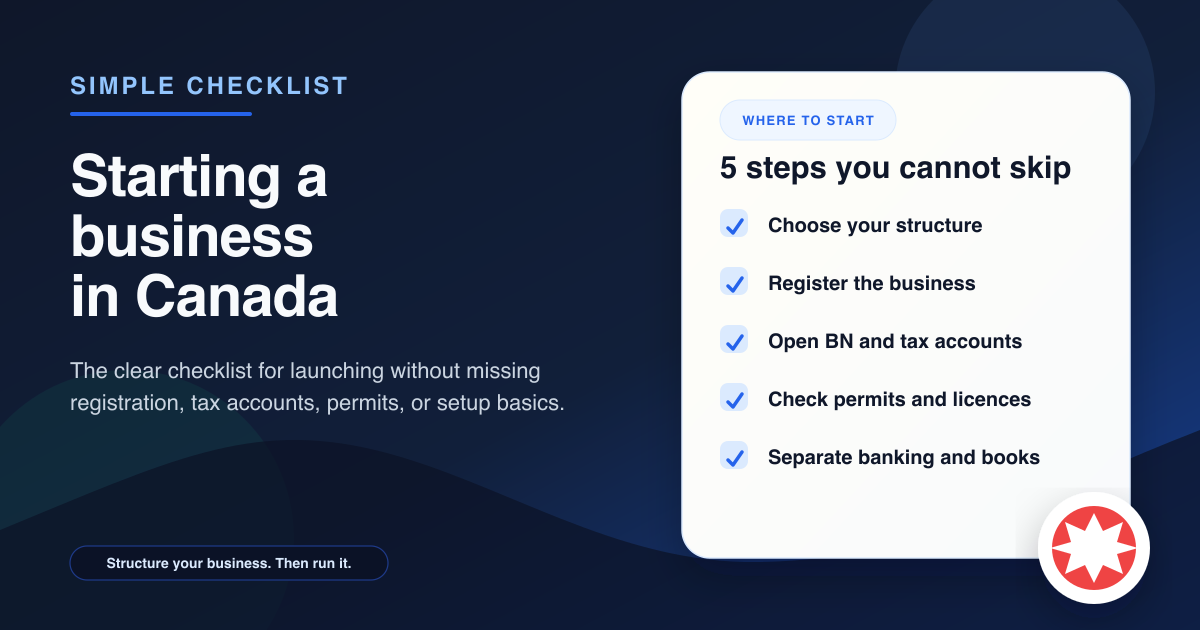
Starting a Business in Canada Checklist: Registration, BN, GST/HST, Permits and First 90 Days
Use this practical starting a business in Canada checklist to choose a structure, complete business registration, get a Business Number, handle GST/HST, check permits, and plan your first 90 days.
Vision, Mission, and Values: Examples That Actually Mean Something
A practical guide to writing a vision, mission, and core values your team can actually use, with real examples across different kinds of businesses and a 60-second AI generator inside TowerZ.