How to Price Your Services (2026 Pricing Strategy Guide)
How to price your services without guessing. A practical method for salons, coaches, clinics, and studios, with a TowerZ-ready dashboard.
How to Price Your Services: A Practical Pricing Strategy for Service Businesses (2026)
Ask most service business owners how they set their prices, and the answer is variations of the same thing: "I checked what the person down the street was charging, added ten percent, and called it a day."
That is not a strategy. It is a race to the bottom disguised as market research.
How you set your rates is the single lever that most reliably changes the profitability of a service business, and it is also the one owners are the least confident touching. Undercharge and you work harder for less. Overcharge without a story and you lose clients. Get the strategy right, and everything else, marketing, hiring, growth, gets easier.
Here is a practical pricing method built specifically for service businesses in 2026.
Why Service Pricing Is Different From Product Pricing
Products have inventory, unit costs, and shipping. Services have your time, your expertise, and your capacity. Those don't scale the same way, and pricing has to reflect that.
Three things make service pricing hard:
- Your time is finite. You can only serve a certain number of clients per week. Beyond that, you either raise prices or burn out.
- Perceived value dominates. Two identical haircuts, one at $40 and one at $80, are not the same haircut in the client's mind. Positioning matters as much as the service itself (research on pricing psychology, summarized by Nick Kolenda, documents this repeatedly).
- Local comparison distorts everything. Clients compare you to the local competitor, not to the value you deliver. Breaking that comparison is a strategic move.
Any method that ignores those three realities will produce prices that either burn you out or leave money on the table.
The 5 Pricing Approaches (and When Each Works)
There is no single correct method. There are five, and mature service businesses use combinations of them.
1. Cost-Plus
Add up direct costs, add a target margin, that is the price.
Works for: setting a floor. Never sell below cost-plus-a-margin. Doesn't work for: premium services or when your expertise carries most of the value.
2. Competitor-Based
Look at what similar businesses charge in your area and price within that range.
Works for: commodity services (basic cuts, standard massage, generic consultations) where clients genuinely comparison-shop. Doesn't work for: differentiated services. If you price like everyone else, you compete like everyone else.
3. Value-Based
Price based on the outcome the client gets, not on your time. A career coach whose clients get 30-40 percent salary increases can charge more than one who charges by the hour, because the outcome is worth more than the hours.
Works for: coaching, consulting, specialized services, premium positioning. Doesn't work for: services where the outcome is hard to measure or attribute.
4. Packages
Bundle services into fixed packages instead of à la carte pricing. Instead of $80 haircut + $40 wash + $60 treatment = à la carte, offer "Signature Experience: $180" that includes all three.
Works for: increasing average ticket, reducing decision fatigue, moving upmarket. Doesn't work for: clients who only want one specific service and won't pay for extras.
5. Tiered
Three tiers (usually) at different price points, with clear feature differences. Standard, premium, executive.
Works for: nudging clients toward the middle tier (which is typically the profit sweet spot) and capturing high-value clients who want the top tier. Doesn't work for: single-service operations where tiers feel artificial.
Most successful service businesses use a mix: cost-plus as a floor, competitor scan for commodity services, value-based for signature services, packages to lift average ticket, tiers to capture the high end.
How to Actually Set a Price (a 4-Step Method)
Here is the method that works, applied consistently.
Step 1: Calculate Your Real Hourly Cost
Add up all monthly fixed costs (rent, insurance, software, salary you want to pay yourself, benefits). Divide by billable hours available per month, which is typically 60-70 percent of your total working hours (the rest is admin, marketing, no-shows).
That number is your break-even hourly cost. Any price below that means you are losing money on that service.
Step 2: Add Your Target Margin
For a healthy service business, gross margin per service should be 50-70 percent. So if your break-even hourly cost is $50, your target price should be $100-170 per hour.
Step 3: Test Against the Market
Now compare to competitors. If your target price is dramatically above the market, you need either strong differentiation or a repositioning strategy. If it is below, you are probably underpricing.
Step 4: Add the Value Premium
Where you have real expertise, specialization, credentials, results, or track record, add 20-40 percent to your competitor-adjusted price. That is your value premium, and it is what separates you from the commodity market.
When and How to Raise Prices
Every service business owner has this conversation with themselves eventually: "I need to raise my prices, but I am afraid I will lose clients."
Data from thousands of service businesses is consistent: a 10-15 percent price increase, communicated properly, loses 5-15 percent of clients but grows revenue 5-10 percent net. And the clients who leave are often the price-sensitive, high-maintenance ones.
The framework:
1. Announce 30-60 days in advance. Never spring a price change on active clients.
2. Explain the reason briefly. "Rising supplier costs and continued investment in [something clients value]." Avoid over-explaining.
3. Give existing clients a grace period. Current pricing honored for 60-90 days after the change, then transition.
4. Consider grandfathering VIPs. Your top 10-20 percent of clients can keep old pricing for 6-12 months as a loyalty benefit.
5. Raise consistently, not dramatically. A 5-10 percent increase every 12 months is more sustainable than a 30 percent hike every 5 years.
Common Mistakes
- Charging by the hour when the outcome is what matters. Clients don't buy hours, they buy results.
- Not tracking effective hourly rate. Look at monthly revenue divided by actual hours worked. It is almost always lower than the sticker price suggests.
- Discounting to attract new clients without a plan to raise them later. New clients acquired at 30 percent off almost never accept full price later.
- Matching a low-cost competitor. If someone charges 40 percent less than you, you cannot win by lowering. You have to differentiate.
- Not revising your rates for 3+ years. Costs go up. Your prices should too.
How TowerZ Helps You Price Smarter
Pricing is not a single decision, it is a system. Your rates affect your revenue, your capacity, your marketing message, your positioning, and your cash flow.
Inside TowerZ, rates are connected across the platform:
- Services Management where you define, categorize, and price every service
- Market Intelligence to test rate changes with real clients via micro-polls before you commit
- Financial Forecasting to model the revenue impact of a rate change before you announce it
- Analytics to track effective hourly rate, service popularity, and profit per service
- AI Writer to draft the client communication when you change prices
The Operations pillar contains the tactical tools. The Business Analysis pillar contains the strategic view. Together, pricing becomes a decision backed by data, not gut feel.
Ready to price with confidence?
Try TowerZ for free and audit your pricing in under an hour.
Frequently Asked Questions
Should I put my prices on my website? Yes, in almost every case. Transparent pricing filters price-shoppers before they take your time, and builds trust with serious buyers. The businesses that hide prices usually do so because they are inconsistent, not because it works.
How often should I raise prices? Every 12 months, by 5-10 percent, is the sustainable pattern. Waiting 3+ years then hiking 30 percent is what damages client relationships.
What if my competitor charges way less? Two options: differentiate (specialization, credentials, experience, brand) or serve a different segment. Matching a lower price rarely works in services because your fixed costs don't shrink to match.
How do I price a brand-new service I have never sold? Start with cost-plus to set a floor, then look at what similar services charge in other markets. Launch at the middle of that range, and adjust after 30-90 days based on demand.
Is package pricing better than à la carte? For most service businesses, packages lift average ticket by 20-40 percent and reduce client decision fatigue. Keep à la carte available for edge cases, but promote packages as the primary offer.
TowerZ is built for service businesses that want to grow with intention. The Services, Analytics, Financial Forecasting, and Market Intelligence modules together turn pricing from an anxious guess into a decision system.

About Orléando Dassi
Chief Executive Officer & Co-Founder
Orléando leads product vision, business strategy, and the long-term direction behind Automathing Group Inc. and TowerZ. He combines 12+ years in IT with a bachelor's degree in software development, business launch (ASP) training, and an MBA in progress at Université de Sherbrooke.
Related articles
Business Diagnostic: 12 Questions to See What to Fix First
A practical business diagnostic with a scorecard, signal reading, and a worked example so you know what to fix first.
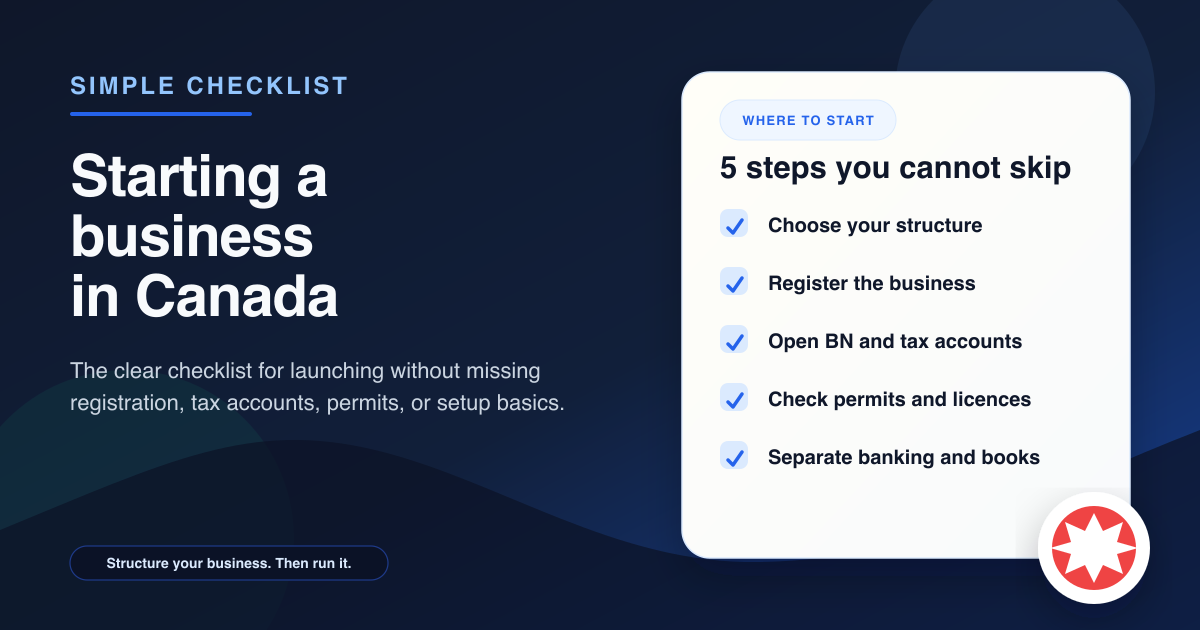
Starting a Business in Canada Checklist: Registration, BN, GST/HST, Permits and First 90 Days
Use this practical starting a business in Canada checklist to choose a structure, complete business registration, get a Business Number, handle GST/HST, check permits, and plan your first 90 days.
Vision, Mission, and Values: Examples That Actually Mean Something
A practical guide to writing a vision, mission, and core values your team can actually use, with real examples across different kinds of businesses and a 60-second AI generator inside TowerZ.