Why Your Marketing Problem Is Actually an Operations Problem
A simple framework to separate a real marketing problem from an operations leak caused by follow-up, no-shows, retention, capacity, or pricing.
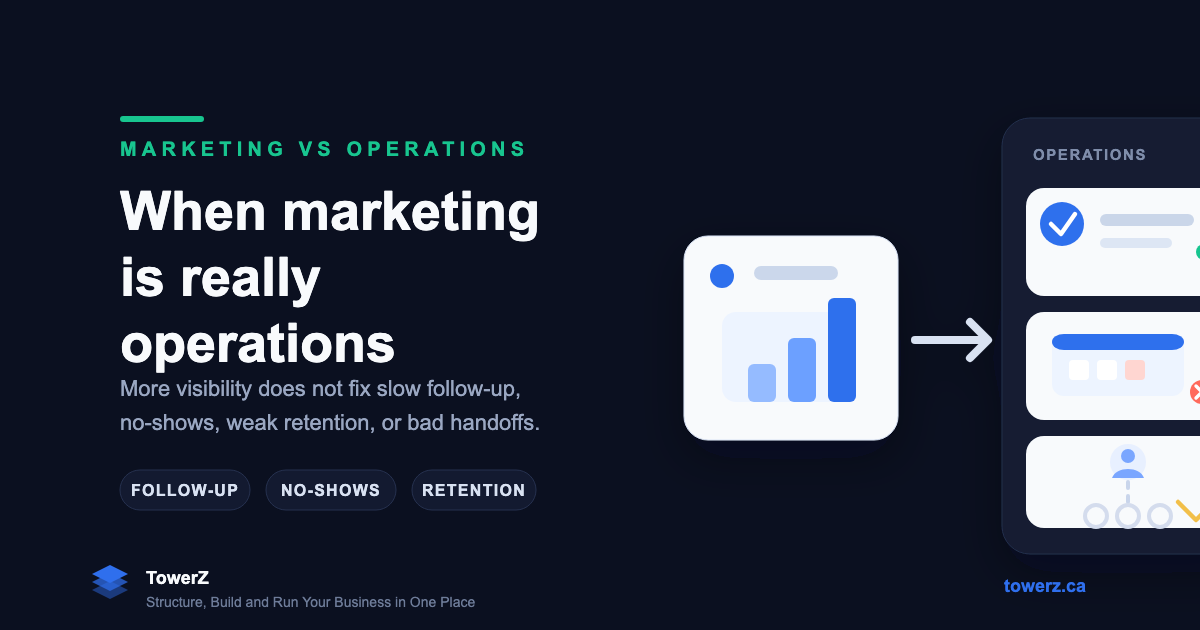
Why Your Marketing Problem Is Actually an Operations Problem
When sales slow down, many businesses reach for the same conclusion:
we need more marketing.
More content. More ads. More visibility. More reach. More leads.
Sometimes that is true.
But in many businesses, the real problem is not at the top of the funnel. It is inside the machine that turns attention into revenue, and then revenue into retention.
In other words, you do not always have an attention problem. You often have a problem not losing the value you already attracted.
The most useful test before buying more acquisition
Before adding budget or content, ask this:
Is demand already entering the business, but degrading afterward?
For example:
- inbound inquiries sit too long without a response;
- booked appointments do not show up;
- quotes go out but never get followed up;
- clients buy once and disappear;
- the team is already overloaded;
- the offer sells, but leaves too little margin.
If the answer is yes, your issue may not be marketing. It may be an operations leak.
What a real marketing problem actually looks like
To stay fair, real marketing problems absolutely exist.
You probably do have a real marketing problem if:
- almost nobody discovers your offer;
- your message attracts the wrong audience;
- the market does not clearly understand what you do;
- no channel generates repeatable demand;
- traffic exists, but qualified interest is almost absent from the start.
In that case, the right work is offer clarity, audience definition, positioning, and distribution. Our article on business strategy is a strong place to start.
But if inbound signals already exist, even modestly, the real question changes:
what is preventing that demand from becoming healthy growth?
Real marketing problem or operations leak? A quick sorting table
| Observed signal | Most likely reading |
|---|---|
| Very little traffic, very few inquiries, and a confused market | Marketing, offer, or positioning problem |
| Inquiries arrive, but replies are slow or inconsistent | Follow-up operations leak |
| People click or ask for info, then drop during the journey | Conversion operations leak |
| Bookings exist, but no-shows stay high | Confirmation and commitment operations leak |
| Clients buy once, then disappear | Retention and follow-up operations leak |
| The calendar fills, but margin does not improve | Economics, capacity, or pricing problem |
| The top of funnel is empty despite a solid offer and journey | More likely a marketing problem |
The classic mistake is treating all of these as if they had the same answer: more visibility.
Four very concrete scenarios that trap teams and founders
The examples below are not universal benchmarks. They are practical field-style scenarios that make diagnosis cleaner.
1. "We need more leads" when the real issue is follow-up
Imagine 18 inquiries in 30 days.
- 7 get a reply within an hour;
- 6 get a reply the next day;
- 5 get a late or vague answer;
- no quote follow-up cadence exists.
At the end of the month, the owner concludes: "we need more leads."
The real issue is elsewhere: existing demand is not being converted consistently.
Useful read: if response speed changes based on schedule, memory, or stress level, that is not a reach problem. It is a system problem.
2. "Our campaigns do not convert" when the client journey leaks
Traffic reaches the page.
But then:
- the offer needs too much explanation;
- the form is too long;
- the booking flow does not feel reassuring;
- payment or confirmation is unclear.
Here, marketing may be working perfectly well. It is the move from interest to action that breaks.
Useful read: if clicks, visits, or messages exist, audit the journey before blaming the campaign.
3. "Acquisition is too expensive" when retention is weak
When a client buys only once, every new client feels expensive. That is not only an acquisition problem. It is often a client lifetime value problem.
Common patterns include:
- no structured follow-up after the first purchase;
- no rebooking ask;
- a decent first experience, but not a memorable one;
- no clear next step.
Our guide on client retention goes deeper on this logic.
Useful read: if you are constantly replacing clients who could have stayed, marketing is paying for a retention problem.
4. "We need more volume" when capacity or pricing are wrong
A team can look busy while still operating poorly.
Common examples:
- profitable time slots are underused;
- some offers consume too much time for too little margin;
- the calendar fills, but cash does not improve;
- the founder’s time absorbs every critical follow-up step.
Our article on KPIs for a service business makes this block easier to see. The article on pricing services is the natural companion.
Useful read: if more clients mainly add fatigue, your first problem is not marketing.
The reusable framework: marketing or operations in 10 minutes
Before raising the budget, run these eight questions.
Block A: does demand already exist?
- Are prospects already coming in, even at low volume?
- Is the right kind of prospect arriving, or mostly poor-fit inquiries?
If the answer is no to both, the problem is more likely marketing than operations.
Block B: is conversion leaking?
- Are replies fast and consistent?
- Is it easy to move from first interest to call or booking?
If demand exists but this block is weak, you likely have a conversion operations leak.
Block C: does execution hold after the sale?
- Do people actually show up to appointments?
- Are payment, welcome flow, and onboarding smooth?
If prospects make it to booking but value gets lost afterward, that is not a marketing problem.
Block D: does growth remain healthy?
- Do clients come back, or does acquisition reset to zero every month?
- Do you have the capacity and margin to absorb more volume?
If retention and margin are weak, increasing visibility too early can make the system worse.
How to decide what to fix first
The right order is rarely "campaign first."
Step 1: close the leaks closest to cash
Start with whatever destroys value immediately:
- slow response time;
- missing follow-up;
- no-shows;
- fragile booking flow;
- confusing payment;
- slow onboarding.
For no-shows and onboarding, our articles on reducing no-shows and client onboarding are the best next reads.
Step 2: restore basic visibility into the machine
You do not need a heavy dashboard. You need enough clarity to steer:
- inquiry volume;
- average response time;
- conversion rate;
- no-show rate;
- retention rate;
- revenue and margin by offer.
Step 3: fix retention, capacity, or pricing
As long as clients do not stay, margin stays thin, or capacity stays messy, acquisition will keep feeling insufficient.
Step 4: push marketing once the machine holds
Marketing becomes far more profitable when:
- replies are fast;
- the journey is clear;
- clients show up;
- follow-up exists;
- retention is not left to chance;
- the business can absorb more volume.
At that point, you are amplifying a system that converts, not a leak.
When the problem really is marketing
To avoid overcorrecting in the other direction, these are the cases where you really should return to marketing:
- almost nobody discovers the offer;
- the right clients do not recognize themselves in the message;
- the promise is blurry;
- the market cannot see how you differ from alternatives;
- demand is too weak before any internal process even gets involved.
In those cases, returning to offer clarity, positioning, and distribution is the right move.
The real takeaway
Marketing attracts attention.
Operations turn that attention into:
- bookings;
- payment;
- experience;
- retention;
- healthy growth.
When operations are weak, marketing always looks insufficient, even when it is not the central issue.
The better question is:
are we truly invisible, or are we mostly losing what we already attract?
FAQ about marketing vs. operations
How can I quickly tell whether my issue is really marketing? If traffic is very low, inbound demand is very low, and the market does not understand the offer from the start, the issue is probably marketing or positioning.
What if I have some of both? That is common. Usually start with the leak closest to cash: follow-up, conversion, no-shows, payment, or retention. Then amplify acquisition.
Why do teams confuse marketing and operations so often? Because lower sales are visible, while operational losses are diffuse. You feel the missing outcome before you see the mechanism causing it.
Is retention really part of operations? Yes. It depends on the client journey, welcome flow, follow-up, rebooking, consistency, and the systems behind the experience.
Can good marketing compensate for bad operations? Sometimes in the short term. Almost never in the medium term. It usually amplifies the flaws instead of hiding them.
Fix the right problem before buying more attention
The most expensive reflex is funding the symptom.
The most profitable reflex is diagnosing the whole machine, then fixing the real bottleneck.
If you want a clearer read on where the blockage sits across Analysis, Planning, and Operations, the APO Diagnostic™ was built specifically to surface this kind of fake marketing problem before it costs you an entire quarter.

About Orléando Dassi
Chief Executive Officer & Co-Founder
Orléando leads product vision, business strategy, and the long-term direction behind Automathing Group Inc. and TowerZ. He combines 12+ years in IT with a bachelor's degree in software development, business launch (ASP) training, and an MBA in progress at Université de Sherbrooke.
Related articles
Business Diagnostic: 12 Questions to See What to Fix First
A practical business diagnostic with a scorecard, signal reading, and a worked example so you know what to fix first.

Google Business Profile Guide for Service Businesses (2026)
How to set up, optimize, and grow your Google Business Profile for a local service business. Real steps, real signals, and how to feed it from TowerZ.
Customer Journey Mapping: 7-Stage Method
A practical customer journey mapping method for service businesses: the 7 stages, a real clinic example, and a TowerZ-ready workflow that runs the loop for you.