How to Write a Business Plan for a Service Business (2026)
A practical, no-fluff business plan template for service entrepreneurs. What to include, what to skip, and how to keep it useful past week one.
How to Write a Business Plan for a Service Business (2026 Guide)
Most business plans die in a drawer. Not because they were badly written. Because they were built for a bank, an accelerator, or a business school professor, and had nothing to do with running the actual business.
A working business plan for a service entrepreneur is different. It is short, it is honest, and it exists to make decisions easier this week, not to impress a stranger in a boardroom.
This guide walks through what to include in a service business plan (aligned with the BDC's business plan template) in 2026, what to skip, and how to keep it useful for more than 30 days. For a formal plan template, the BDC's free business plan template is a widely used Canadian baseline.
What a Business Plan Actually Is (and What It Isn't)
A business plan is not a marketing document. It is not a fundraising pitch. It is not a 40-page academic exercise.
A working business plan is a one-page-per-section summary of how you intend to build and run a business, with enough specificity that you (and anyone reading it) can tell whether you know what you are doing. For a service business, the plan is closer to an operating manual than a legal filing.
If you need a version for a bank or investor, you will format a different document from the same source. But the working plan comes first.
The 8 Sections That Actually Matter
Here is a service-business-specific plan structure that works in practice.
1. Executive Summary (Write This Last)
Half a page. Who you serve, what you sell, what makes you different, and where you want the business to be in 24 months. Skip generic phrases like "leverage synergies" or "disrupt the industry." Write in plain sentences.
2. Vision, Mission, Values
Not decoration. The vision describes where you are going in the next 5 to 10 years. The mission grounds your daily work and defines who you serve today. The values decide who you hire and how you say no. If you cannot repeat them from memory, they are too long.
For a deeper method on writing usable statements, see our guide on Vision, Mission, and Values.
3. Market and Client Analysis
Who is the client (specifically), and how many of them exist in your area. Include:
- The three client segments you actually plan to serve
- Their real problem, in their own words
- Roughly how many exist locally and how they currently solve the problem
- A PESTEL scan of your external environment (see our PESTEL guide)
Avoid the temptation to make the market look enormous. Investors and lenders both prefer a smaller market you understand precisely.
4. Competitive Analysis
A quick, honest competitor analysis with 3 to 5 named competitors, their pricing, their strengths, and their credible weaknesses. Then a single sentence: "Here is why a client picks us over them."
5. Services and Pricing
For each service you plan to sell:
- What it is, in one sentence
- Who buys it
- Price and duration
- Gross margin per hour of your time
This section forces the honest question: which service actually generates profit, and which one is a hobby?
6. Marketing and Sales Plan
How new clients discover you (channels), what they do next (funnel), and what the plan is to reach the first 100. Include:
- Two channels you commit to for the first 90 days (Instagram, referrals, Google, partnerships, etc.)
- A content calendar skeleton
- A link in bio and public page strategy
- Realistic conversion assumptions
7. Operations
The daily engine. Where clients book, how they pay, how you deliver the service, how you handle no-shows, and who does what. Include:
- Booking and scheduling system
- Payment collection and deposits (see our Quebec invoice guide if you operate in Quebec)
- Team roles and permissions if you have staff
- Standard client experience, step by step
8. Financial Plan
A 12-to-24-month projection with three scenarios: pessimistic, base, optimistic. Include:
- Monthly revenue by service
- Fixed and variable costs
- Cash flow
- Break-even point
- Personal salary
For a step-by-step method, see our upcoming guide on financial forecasts for service businesses.
What to Skip (and Why)
Most business plan templates include sections that produce zero decisions. For a service business, you can generally skip:
- Detailed SWOT reproduced in the plan. Do it separately (see our SWOT guide) and reference the conclusions here in one paragraph.
- A 15-page industry overview. Cite three real sources in 2 paragraphs.
- Complex org charts for a 2-person operation. A simple RACI or job-role list is enough.
- A 5-year revenue projection built on 2 percent monthly growth. Nobody believes it. Two years, three scenarios, is more credible.
The plan should be under 15 pages for a solo operator. Under 25 for a small team. Anything longer signals that the writer is trying to convince themselves, not the reader.
How to Keep It Alive (the 90-Day Rule)
Every business plan lies within 30 days of being written. That is normal. What is not normal is treating the plan as a static document that gets abandoned.
Three rules keep a plan useful:
1. Set a quarterly review date the day you finish the plan. Put it in your calendar. Non-negotiable.
2. Track 3 to 5 KPIs against the plan monthly. Not 20. Three to five KPIs that show whether the plan is holding (see our upcoming guide on KPIs for service businesses).
3. Update the plan every quarter, not every three years. A living plan is worth more than a beautiful plan.
Business Plan and Business Strategy: Not the Same Thing
The plan is a static document. The strategy is a living system.
The plan lists your goals, milestones, personas, KPIs. The strategy is how you actually execute against them week to week. TowerZ's Business Strategy canvas turns the goals and KPIs from your plan into an interactive mind-map, so the plan does not just describe the business, it drives it.
Build Your Business Plan Faster with TowerZ
Writing a business plan from scratch takes days. TowerZ generates the foundational sections from your business profile in minutes: vision and mission, market context, SWOT, PESTEL, BMC, competitors analysis, and a first strategy canvas with goals, KPIs, and milestones.
You still write the human parts (why you started, what you refuse to do, why this year). But the analytical scaffolding is generated, connected, and updates itself when you change one input. Your plan becomes a live document instead of a Word file.
The plan pieces connect naturally to the Business Analysis and Business Strategy modules, then to Operations for execution.
Ready to build a plan you will actually use?
Try TowerZ for free and generate your first business plan foundation in under 30 minutes.
Frequently Asked Questions
How long should a service business plan be? For a solo operator, 10 to 15 pages. For a small team, 20 to 25. Longer plans get ignored, not read.
Do I need a business plan if I am not raising money? Yes, but a different one. A financing plan is written for outsiders. A working plan is written for you. Both are useful, but they answer different questions.
How often should I update the plan? Full review every 6 to 12 months. Light update every quarter. Anything longer than a year and it stops describing the actual business.
What is the biggest mistake owners make? Writing the plan as marketing. A plan should be honest about weaknesses and risks. If it reads like a brochure, it is not helping you make decisions.
Do I need financials if I am just selling my time? Yes. Especially if you are just selling your time. You need to know your break-even, your effective hourly rate, and how many billable hours you can actually deliver per week without burning out.
TowerZ is built for service businesses that want to grow with intention. The Business Analysis and Business Strategy modules together turn a static plan into a connected system of goals, KPIs, and actions.

About Orléando Dassi
Chief Executive Officer & Co-Founder
Orléando leads product vision, business strategy, and the long-term direction behind Automathing Group Inc. and TowerZ. He combines 12+ years in IT with a bachelor's degree in software development, business launch (ASP) training, and an MBA in progress at Université de Sherbrooke.
Related articles
Business Diagnostic: 12 Questions to See What to Fix First
A practical business diagnostic with a scorecard, signal reading, and a worked example so you know what to fix first.
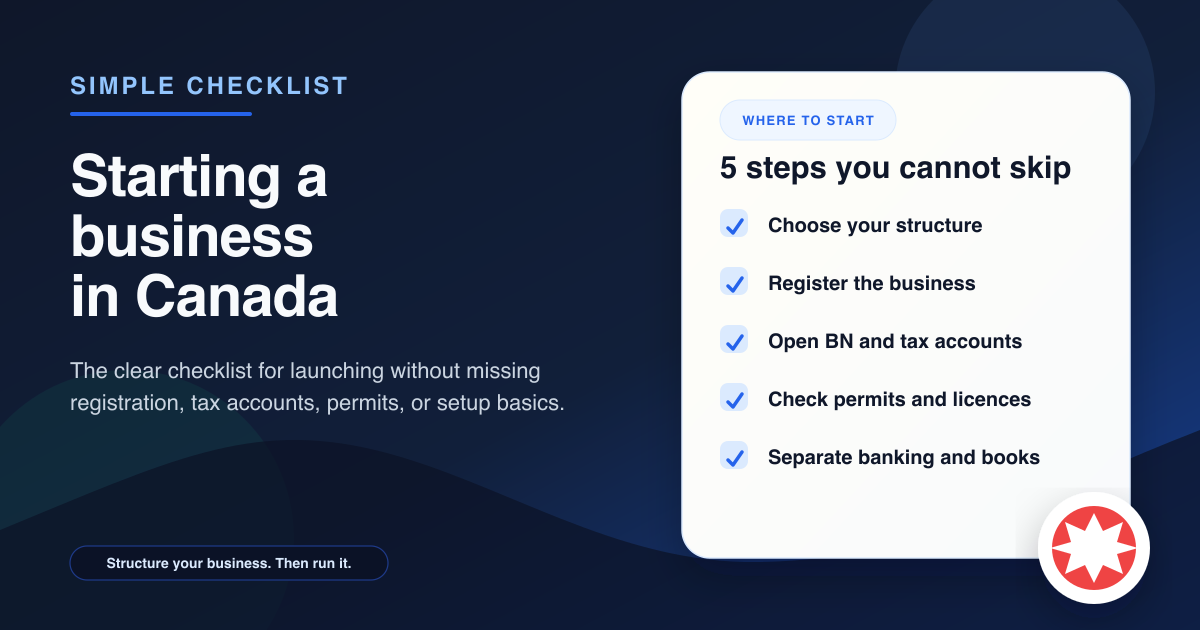
Starting a Business in Canada Checklist: Registration, BN, GST/HST, Permits and First 90 Days
Use this practical starting a business in Canada checklist to choose a structure, complete business registration, get a Business Number, handle GST/HST, check permits, and plan your first 90 days.
Vision, Mission, and Values: Examples That Actually Mean Something
A practical guide to writing a vision, mission, and core values your team can actually use, with real examples across different kinds of businesses and a 60-second AI generator inside TowerZ.