Business Diagnostic: 12 Questions to See What to Fix First
A practical business diagnostic with a scorecard, signal reading, and a worked example so you know what to fix first.
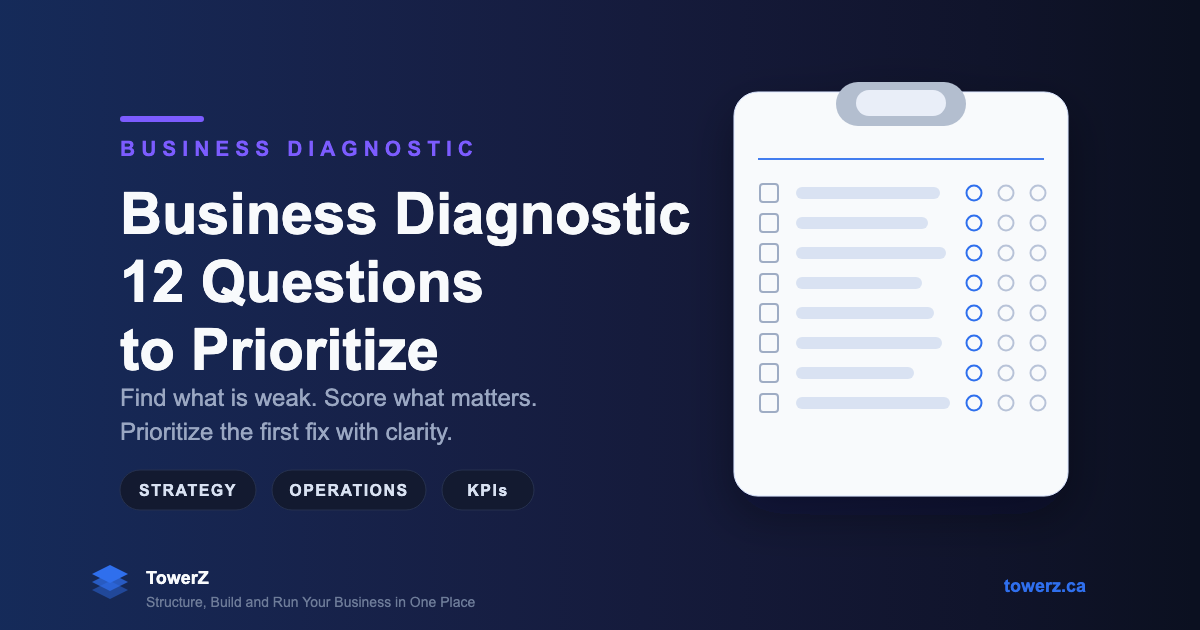
Business Diagnostic: 12 Questions to See What to Fix First
If you are searching for how to do a business diagnostic, a business assessment template, a scorecard, or a quick business health check, the goal is not to produce a beautiful report.
The goal is to reach a clear decision.
Most businesses do not lack ideas. They lack a clean way to separate:
- a demand problem;
- an economics problem;
- an operations leak;
- a leadership and prioritization problem.
This business diagnostic is designed to help you see where the machine is actually breaking and what to fix first.
What this diagnostic is really for
This is not a full financial audit or a 12-month strategy plan.
It is a practical business assessment for a company, clinic, studio, consultancy, or any team selling time, appointments, expertise, or a repeatable service.
By the end, you should be able to say:
- which block is weakest;
- which signal deserves attention before the others;
- which fix could create a visible effect inside 30 days.
How to use the scorecard
For each question, give yourself a score:
- 0 = no, missing, or completely unclear;
- 1 = partly true, inconsistent, or dependent on one person;
- 2 = yes, clear, measured, and reasonably stable.
You can do this in 30 to 45 minutes with:
- your booking calendar or pipeline;
- your last 30 to 90 days of sales data;
- your notes on complaints, no-shows, delays, or follow-up gaps;
- some honesty about what still depends on you.
Business diagnostic scorecard: the 12 questions
| Question | 0 points | 1 point | 2 points |
|---|---|---|---|
| 1. Do you know why your best clients choose you? | You mostly guess | You have a rough idea, not a stable answer | You can explain it clearly in one sentence with examples |
| 2. Are leads coming from the right channels? | Lots of poor-fit demand | A mix of good and weak-fit leads | Most channels bring the right kind of client |
| 3. Is your offer understood in under 10 seconds? | It takes too much explaining | It is somewhat clear, but not sharp | Offer, audience, and value are obvious quickly |
| 4. Do you know which offers create the most margin? | You are guessing | You have partial numbers | You know which offers are truly most profitable |
| 5. Can you estimate the next 30 days of revenue? | Every month surprises you | You can sense a trend, but not confidently | You have a reasonable read on pipeline and capacity |
| 6. Do you know your cash buffer? | No real visibility | Rough sense only | Clear sense of buffer and risk thresholds |
| 7. Do you know where value is lost between interest and payment? | No journey visibility | You see a few leaks, not clearly measured | The main leaks are identified clearly |
| 8. Does a new client experience value quickly? | Slow or confusing start | Good in places, uneven overall | New clients are guided and reassured quickly |
| 9. Do the same frictions keep repeating? | Yes, often, with no lasting fix | A few recurring issues remain | Repeat issues are rare or already addressed |
| 10. Are you tracking 3 to 5 useful KPIs? | No real rhythm | A few numbers, not reviewed consistently | A short KPI set reviewed weekly |
| 11. Is there one critical bottleneck that depends almost entirely on you? | Yes, heavily | Still somewhat | The system can run without one person holding it together |
| 12. If revenue dropped 20%, would you know what to fix first? | No | Maybe, but not clearly | Yes, the first priority would be obvious |
Quick read of the total score
- 0 to 8: urgent priority. You do not have a small issue. You need to rebuild basic visibility.
- 9 to 16: viable but blurry. One or two blocks are probably slowing everything else down.
- 17 to 20: healthy base with specific leaks or blind spots.
- 21 to 24: strong structure. The diagnostic becomes a steering tool more than a rescue tool.
The total score helps, but the real value comes from the score by block.
Block-by-block interpretation
Block 1: Demand and market clarity
Questions 1 to 3.
- 0 to 2: likely positioning, offer, or message problem.
- 3 to 4: the market understands something, but not sharply enough.
- 5 to 6: the commercial base is clear.
If this block is weak, start with promise, audience, and offer clarity. The next useful move is often revisiting your business strategy, Business Model Canvas, or a SWOT analysis.
Block 2: Economics, margin, and cash
Questions 4 to 6.
- 0 to 2: you may be growing in the wrong direction.
- 3 to 4: activity exists, but the economics are still fragile.
- 5 to 6: you have enough visibility to make calmer decisions.
If this block is weak, revisit pricing, margin by offer, and cash forecasting before buying more acquisition. Our articles on KPIs for a service business and financial forecasting are the best follow-up here.
Block 3: Operations and client journey
Questions 7 to 9.
- 0 to 2: value is already leaking through the system.
- 3 to 4: the journey works, but unevenly.
- 5 to 6: execution supports growth instead of slowing it down.
If this block is weak, start with response time, no-shows, payment flow, onboarding, and follow-up. Our articles on reducing no-shows, client onboarding, and client retention are the best next reads.
Block 4: Leadership and prioritization
Questions 10 to 12.
- 0 to 2: you are reacting more than steering.
- 3 to 4: some visibility exists, but the decision rhythm is weak.
- 5 to 6: you can prioritize without defaulting to panic.
If this block is weak, do not add more tools. Install a simple rhythm: 3 to 5 KPIs, one short weekly review, and one improvement priority at a time.
Worked example: a clinic that thinks it has a marketing problem
Here is a simple example.
A clinic team says, "we need more visibility."
After running the diagnostic:
- Block 1: 4/6
- Block 2: 3/6
- Block 3: 1/6
- Block 4: 2/6
- Total score: 10/24
What that means
The clinic does not primarily have a marketing problem.
The core issue is operational:
- inbound inquiries receive uneven responses;
- pre-visit information is unclear;
- post-visit follow-up is nearly absent;
- the same frictions keep recurring with no system fix.
The weak Block 4 score also shows a leadership problem: nobody is tracking average response time, no-show rate, or 30-day retention.
First fix to make
Not a campaign.
The first fix would be:
- define a response-time target;
- send a clearer confirmation sequence;
- standardize the first-visit experience;
- track four KPIs for 30 days.
Marketing becomes much more effective once that leak is smaller.
How to do a business diagnostic without overcomplicating it
If you were looking for a business diagnostic template or business health check model, use this sequence:
1. Score the 12 questions quickly
Do not over-debate. The goal is not academic precision. It is management clarity.
2. Identify the weakest block
A weak score concentrated in one block usually tells you more than average scores everywhere.
3. Find the symptom costing you the most
Ask:
- what affects cash the fastest?
- what creates the most client friction?
- what still depends too much on one person?
4. Choose one 30-day fix
Examples:
- clarify the main offer;
- reprice one under-margin offer;
- reduce no-shows;
- tighten onboarding;
- install four weekly KPIs.
5. Run the same scorecard again next month
A good diagnostic is not a one-time worksheet. It becomes a rhythm. That is what turns it from a checklist into a business scorecard.
The most common mistakes in business diagnostics
Confusing activity with health
A full calendar is not proof of margin, retention, or a healthy system.
Trying to fix four things at once
When everything looks weak, the temptation is to address everything. In practice, one strong correction usually beats four weak initiatives.
Fixing a visible symptom instead of a structural block
More traffic does not fix a confusing offer. More content does not fix poor follow-up. More effort does not fix bad sequencing.
FAQ about business diagnostics
How do I do a business diagnostic simply? Use the 12 questions, score each from 0 to 2, identify the weakest block, then choose one fix that protects cash, reduces a leak, or sharpens the offer.
Does this business diagnostic scorecard work for a small company or lean team? Yes. It was designed for businesses that need practical clarity without a heavyweight audit, especially when leadership, operations, and economics are still closely connected.
Is this a complete business assessment template? It is a strong starting template for prioritization. Once the weak block is clear, you then go deeper with numbers, processes, and more detailed decisions.
What is the difference between a business diagnostic and a business health check? They are closely related. Here, the focus is not on grading the business in the abstract. It is on identifying the block that is most slowing progress right now.
How often should I run this scorecard? A light version monthly works well. A more deliberate quarterly review helps you see structural patterns over time.
A useful diagnostic should create a decision
The real test is not "was this article interesting?".
The real test is: do you know better what to fix this week than you did before reading it?
If yes, the diagnostic worked.
If you want to go further, the APO Diagnostic™ was designed to turn this kind of signal reading into concrete priorities across Analysis, Planning, and Operations.

About Orléando Dassi
Chief Executive Officer & Co-Founder
Orléando leads product vision, business strategy, and the long-term direction behind Automathing Group Inc. and TowerZ. He combines 12+ years in IT with a bachelor's degree in software development, business launch (ASP) training, and an MBA in progress at Université de Sherbrooke.
Related articles
Why Your Marketing Problem Is Actually an Operations Problem
A simple framework to separate a real marketing problem from an operations leak caused by follow-up, no-shows, retention, capacity, or pricing.
Vision, Mission, and Values: Examples That Actually Mean Something
A practical guide to writing a vision, mission, and core values your team can actually use, with real examples across different kinds of businesses and a 60-second AI generator inside TowerZ.
How to Do a Competitor Analysis (Step-by-Step)
A practical 7-step competitor analysis method. Generate yours in 60 seconds with TowerZ.