How to Do a SWOT Analysis for a Service Business (With Real Examples)
A practical SWOT framework for service entrepreneurs, salons, clinics, coaches, consultants. Real examples and a 60-second AI generator inside TowerZ.
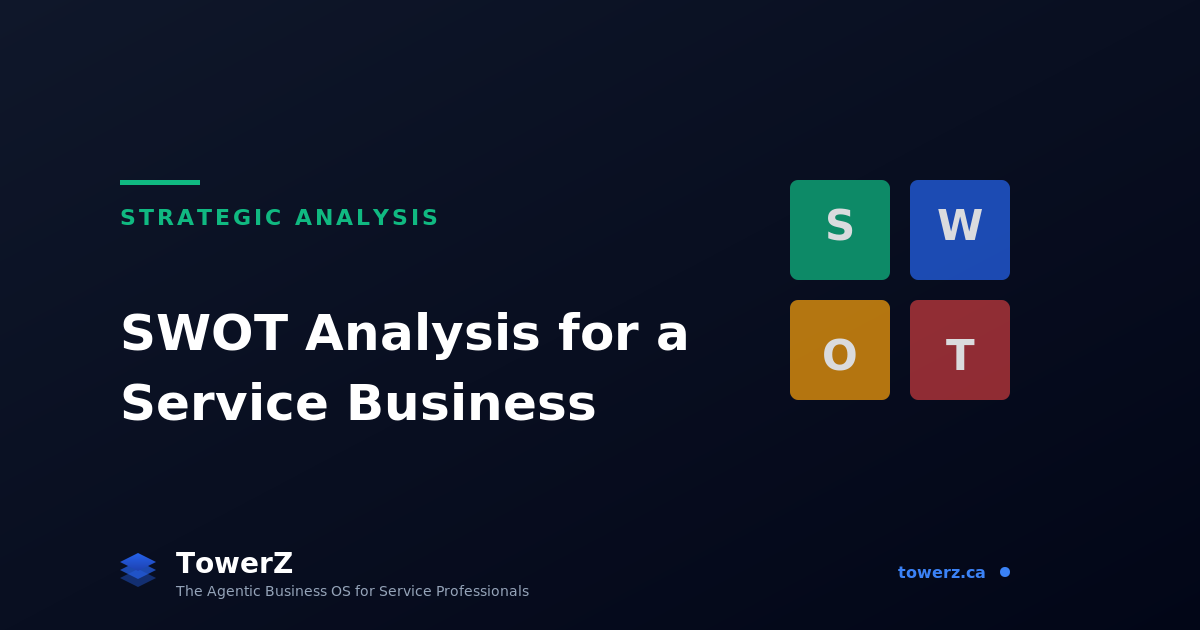
How to Do a SWOT Analysis for a Service Business (With Real Examples)
If you've ever sat down to "work on your business" and ended up scrolling Instagram for an hour, you already know the problem. There is no shortage of things to fix. The hard part is knowing which one to fix first.
A SWOT analysis is the simplest tool that exists to answer that question. It is a one-page snapshot of where your business actually stands, what you are good at, where you are exposed, what's open to you, and what could hurt you. Done honestly, it turns a foggy week into a clear one.
It is also one of the most misused frameworks in business. Most SWOTs end up as a vague list of "good staff" and "competition." That is not analysis. That's a feelings page.
Let's do it properly.
What Is a SWOT Analysis?
SWOT stands for Strengths, Weaknesses, Opportunities, and Threats. Strengths and weaknesses are internal, things inside your business you can act on directly. Opportunities and threats are external, forces in your market you have to read and react to.
The whole point of SWOT is to put internal and external in conversation, on a single page. That conversation is where strategy comes from.
The 4 SWOT Quadrants Explained with a Real Example
Let's use a concrete example throughout: Studio Nord, a massage and wellness clinic in Montreal with two therapists, a small reception area, and a client base of about 250 active clients. Owner-operated. Five years in business.
Strengths: What You Already Do Well
Strengths are the things that make clients pick you over the salon, clinic, or consultant down the street. Be specific. "Good service" is not a strength. "92% client return rate after first visit" is.
For Studio Nord, real strengths include: a 4.9 rating across 180 Google reviews, a senior therapist with 15 years of specialised experience in sports recovery, a downtown location with a paid parking partnership, and a deposit-protected booking system that keeps no-shows under 4%.
Each of those is a fact you can defend with a number or a document. That is the standard.
Ask yourself: What do clients consistently mention in reviews? What can I prove with a number?
Examples of real strengths for service businesses:
- Verified reviews and ratings above sector average
- Specialised expertise or certifications competitors lack
- Strong location, foot traffic, or parking access
- High client retention or referral rate
- Recurring revenue from memberships or packages
- A loyal core team with low turnover
- Proprietary processes or signature offerings
- An engaged social media following with proven conversions
- Owned tools, equipment, or treatment rooms (vs. rented)
Weaknesses: Where You Lose Money or Time
Weaknesses are not personal flaws. They are operational realities that cost you money, time, or client trust. The honest test is: if a smart competitor walked into my business tomorrow, what would they fix first?
For Studio Nord, the honest answers include: no online presence outside Google (no Instagram, no TikTok), no email list, full dependence on the senior therapist for 70% of revenue, and Tuesdays consistently 40% booked while Saturdays are turning clients away.
None of those are catastrophic. All of them are leaks.
Ask yourself: Where am I leaking revenue? What is one person dependent on?
Examples of real weaknesses for service businesses:
- Heavy revenue concentration on one staff member or one service
- No client database or CRM, bookings live in heads and DMs
- Manual scheduling, manual invoicing, manual reminders
- Inconsistent or absent social media presence
- No content system, no marketing calendar
- Pricing not reviewed in 18+ months
- Underused time slots that go empty week after week
- No formal cancellation or deposit policy
- Owner doing tasks that should be delegated or automated
Opportunities: External Trends You Can Ride
Opportunities are forces in your environment that, if you act on them, give you leverage. They are not just things you'd like to happen. They are realistic openings in your market.
For Studio Nord, current opportunities include: rising local demand for sports recovery (linked to a wave of new gyms in the neighborhood), corporate wellness budgets being reinstated at nearby tech offices, a new transit station opening within walking distance, and AI-powered scheduling tools that are now affordable for two-person clinics.
Each of those is something Studio Nord can build a 90-day plan around.
Ask yourself: What trend in my city, sector, or technology stack could I use right now?
Examples of real opportunities for service businesses:
- Underserved niches in your local market (post-pregnancy, seniors, men's wellness, etc.)
- New residential or commercial developments increasing foot traffic
- Rising demand for a sub-service you already offer occasionally
- Corporate wellness or B2B contracts in your area
- Influencer or micro-influencer partnerships in your niche
- AI tools that replace tasks you currently pay for
- Government grants for digital transformation or training
- Partnerships with complementary businesses (gym + massage, salon + photographer)
Threats: External Risks You Need to Watch
Threats are not paranoia. They are real, identifiable forces that could hurt the business if ignored. Naming them is half the defence.
For Studio Nord, current threats include: a new franchise wellness clinic opening four blocks away, rising commercial rents downtown, a labour shortage of certified massage therapists in Quebec, and Law 25 compliance obligations for client records.
Some of those are slow-moving. Some are urgent. But all of them are easier to handle when they are written down and reviewed quarterly than when they ambush you.
Ask yourself: What could go wrong this year that I'm not preparing for?
Examples of real threats for service businesses:
- New competitors opening nearby (franchise, low-cost, or premium)
- Pricing pressure from discount platforms or marketplaces
- Rising rent, utilities, or supply costs
- Labour shortage in your trade
- Regulatory changes (data protection, certifications, taxation)
- Platform commission increases on tools you depend on
- Negative reviews from a single bad incident going viral
- Seasonal downturn or economic slowdown reducing discretionary spend
- Dependency on a single referral source drying up
How to Actually Use Your SWOT (Beyond the Document)
A SWOT only matters if it produces decisions. Here is how to turn your four quadrants into action.
1. Cross your strengths with your opportunities. Where they meet, you find your easiest wins. Studio Nord's senior therapist (strength) + rising sports recovery demand (opportunity) = a clear path to a dedicated sports recovery package, marketed to nearby gyms.
2. Cross your weaknesses with your threats. Where they meet, you find your urgent risks. Studio Nord's missing online presence (weakness) + new franchise opening (threat) = a 90-day plan to build a real Instagram presence before the franchise launches its grand opening.
3. Pick three actions, not thirty. A SWOT can generate dozens of ideas. Discipline matters more than completeness. Pick three actions for the next quarter. Track them.
4. Revisit quarterly. A SWOT is not a one-time exercise. Markets shift, your business shifts. Re-run it every three months, even a 15-minute version is worth it.
SWOT vs PESTEL vs BMC: What's the Difference?
These three frameworks are often confused. Here is the simplest distinction:
| SWOT | PESTEL | Business Model Canvas | |
|---|---|---|---|
| What it looks at | Internal + external | External macro environment | How your business creates value |
| Best for | Picking next quarter's priorities | Understanding what's shifting around you | Mapping your full business model |
| Time horizon | 3-12 months | 12-24 months | Now + future |
The three are complementary. PESTEL feeds the opportunities and threats side of your SWOT. SWOT priorities feed into your Business Model Canvas decisions. None of them stand alone.
Generate Your SWOT in 60 Seconds with TowerZ
Manual SWOTs take hours: structuring the boards, researching your market, writing it all down, then keeping it updated. TowerZ generates a complete SWOT directly from your business profile, strengths, weaknesses, opportunities, and threats, each tagged by impact level and editable inline.
Because it lives inside your TowerZ workspace, your SWOT connects directly to your Business Strategy, your PESTEL, your BMC, your Competitors Analysis, and your APO Diagnostic™. Insights from one board automatically inform the next. You stop maintaining four disconnected documents and start running one connected analysis.
TowerZ's Business Analysis software is built specifically for service entrepreneurs, salons, clinics, coaches, studios, agencies. You stay in control. The AI gives you a strong first draft. You refine, accept, or replace each card.
Ready to see your business clearly?
Try TowerZ for free and generate your SWOT in under a minute.
Frequently Asked Questions about SWOT
How long should a SWOT analysis take? A first version: 90 minutes if you do it manually, under 5 minutes with TowerZ's AI generator. The point is to finish it, not to polish it. A 60% SWOT this week beats a 95% SWOT in three months.
How many items per quadrant? Aim for 3 to 5 per quadrant. More than that and you lose focus. If you have 15 strengths listed, you have not yet decided which ones actually matter.
Should I do a SWOT alone or with my team? Both. Do one alone first, to capture your honest view. Then run it again with your team, they will catch things you missed, especially on weaknesses and threats. The gap between the two versions is itself useful information.
What's the difference between SWOT and a business plan? A business plan is the full document, vision, mission, finances, operations. A SWOT is one input into that plan. You don't replace a business plan with a SWOT. You use SWOT to build the strategy section of one.
How is SWOT different from the APO Diagnostic™? SWOT is a snapshot you write. The APO Diagnostic™ is an AI-scored health check across Analysis, Planning, and Operations, it reads your boards and operational data and tells you where the gaps are. SWOT is the analysis you produce. The APO is the audit of how well you are executing on it.
TowerZ is built for service businesses that want to grow with intention. The Business Analysis module. SWOT, PESTEL, BMC, Competitors Analysis, is one of the tools we built to help owners see clearly and act in the right place.

About Orléando Dassi
Chief Executive Officer & Co-Founder
Orléando leads product vision, business strategy, and the long-term direction behind Automathing Group Inc. and TowerZ. He combines 12+ years in IT with a bachelor's degree in software development, business launch (ASP) training, and an MBA in progress at Université de Sherbrooke.
Related articles
Business Diagnostic: 12 Questions to See What to Fix First
A practical business diagnostic with a scorecard, signal reading, and a worked example so you know what to fix first.
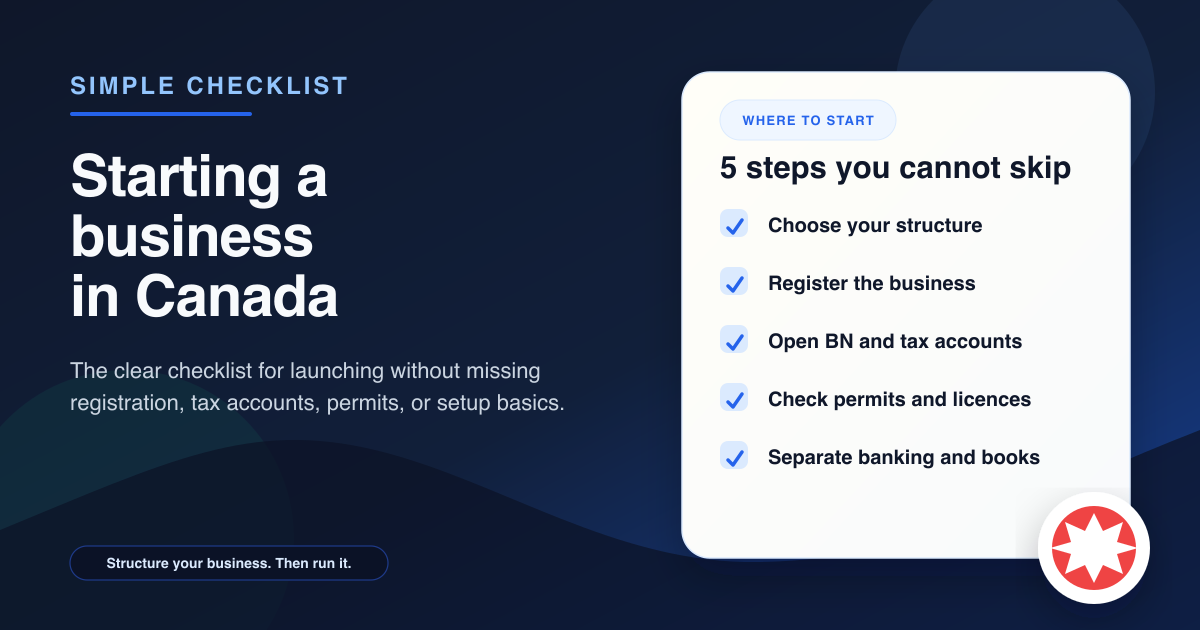
Starting a Business in Canada Checklist: Registration, BN, GST/HST, Permits and First 90 Days
Use this practical starting a business in Canada checklist to choose a structure, complete business registration, get a Business Number, handle GST/HST, check permits, and plan your first 90 days.
Vision, Mission, and Values: Examples That Actually Mean Something
A practical guide to writing a vision, mission, and core values your team can actually use, with real examples across different kinds of businesses and a 60-second AI generator inside TowerZ.