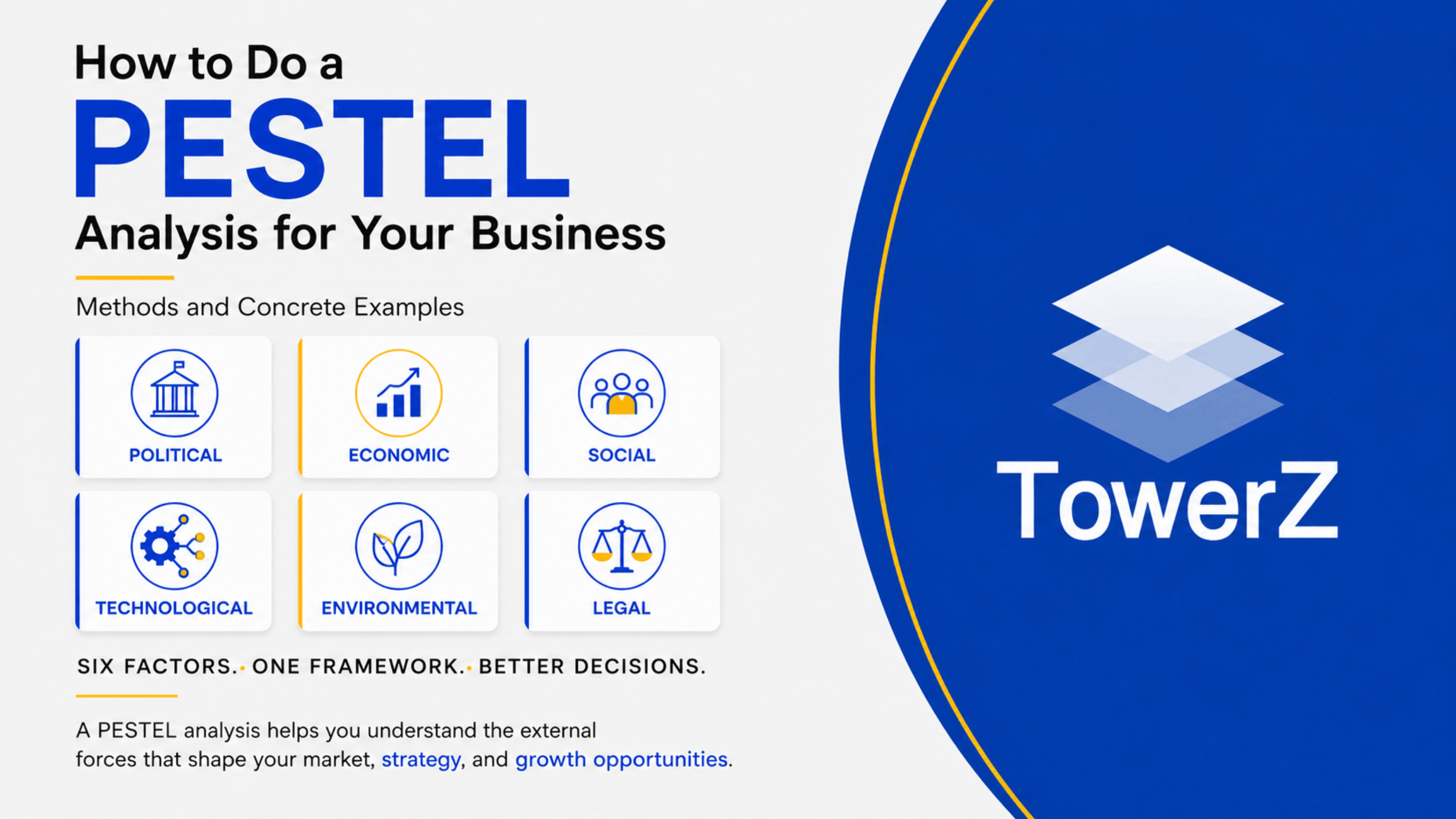
How to Do a PESTEL Analysis for Your Business: Methods and Concrete Examples
Complete PESTEL method with concrete examples for service businesses. Generate yours in 60 seconds with TowerZ AI.
How to Do a PESTEL Analysis for Your Business: Methods and Concrete Examples
Have you ever felt like certain outcomes in your business slipped out of your hands, not because you made the wrong call, but because something around you shifted? A new regulation, an emerging trend, a new competitor entering your market, an economic downturn cooling demand.
That's exactly what PESTEL is designed to surface.
It's not a tool reserved for large corporations or strategy consultants. It's a framework any service business owner can use to see clearly what's happening in their environment and make better decisions because of it.
What Is PESTEL?
PESTEL is a strategic analysis framework that breaks down a business's external environment into six dimensions:
- Political
- Economic
- Social
- Technological
- Environmental
- Legal
The idea is straightforward: your business doesn't operate in a vacuum. External forces, whether you control them or not, constantly influence it. PESTEL gives you a framework to identify, evaluate, and account for them in your decisions.
The 6 PESTEL Dimensions Explained with Examples
Let's walk through each dimension using a real example: Aura Beauty and Wellness, a beauty center in downtown Sherbrooke offering esthetic treatments, waxing, facials, and manicures. A team of 4 certified technicians, serving primarily women aged 25 to 55.
Political: What Governments Impose or Influence
This dimension covers regulations, public policies, and government decisions that affect your sector.
For Aura Beauty, this includes mandatory provincial certifications for esthetic technicians, sanitary standards enforced by public health authorities, and periodic facility inspections. These aren't minor details. They are operating conditions. Ignoring them can mean fines or forced closure.
Ask yourself: What licenses or certifications does your trade require? Are there regulations changing in your sector?
Political factors to examine:
- Sector-specific regulations, licenses, and mandatory certifications
- Local, provincial, and national political stability
- Corporate tax policy and business tax rates
- Government grants, subsidies, and SME support programs
- Employment law and labor standards (minimum wage, leave policies)
- Election cycles and shifts in government priorities
- Consumer protection legislation
- Lobbying activity and advocacy groups in your industry
- Administrative bureaucracy and compliance timelines
- Public funding opportunities and procurement programs
Economic: The Financial Context of Your Clients and Market
During economic uncertainty, some clients reduce visit frequency or trade down to lower-cost services. Retention becomes more valuable than ever: keeping an existing client costs far less than acquiring a new one.
There's also competitive pressure from discount beauty centers and low-cost nail bars targeting the same client pool in Sherbrooke. Without a clear view of this context, Aura risks mispricing its services or underinvesting in client retention.
Ask yourself: Is your clientele sensitive to economic cycles? Who are your competitors on price?
Economic factors to examine:
- Inflation rate and household purchasing power in your area
- Regional unemployment rate and labor market conditions
- Local economic growth and vitality of the commercial landscape
- Interest rates and access to business financing
- Trends in discretionary spending within your service category
- Cost of supplies, raw materials, and equipment
- Competitive pricing pressure in your sector
- Commercial real estate costs and rent trends in your area
- Seasonal demand patterns for your services
- Overall financial health of your target clientele
Social: Trends and Behaviors Shaping Your Clientele
This is often the richest dimension for service businesses. For Aura, two major trends stand out.
The rise of the clean beauty movement, where clients read ingredient labels and ask for cruelty-free, paraben-free products. And Instagram and TikTok have become the primary showcase for beauty centers: a well-composed photo of a facial can outperform a local newspaper ad by a wide margin.
Ask yourself: What values are your clients embracing more and more? How do they find you today?
Social factors to examine:
- Demographic trends and population shifts in your local area
- Changing consumer habits and lifestyle preferences
- Emerging values (wellness, sustainability, inclusivity, authenticity)
- Social media influence on purchasing decisions
- Cultural attitudes toward your type of service
- Evolving family structures and household compositions
- Education levels and quality expectations of your clientele
- Geographic mobility and urbanization in your market
- Weight of online reviews and digital word-of-mouth
- Cultural diversity and specific needs of local communities
- Health, prevention, and wellness trends affecting your sector
Technological: Tools Changing How You Work
Online booking has become a baseline expectation. A client who cannot book an appointment at 10 PM from her phone will simply go elsewhere. It is no longer a competitive advantage. It is table stakes.
AI is also beginning to enter personalized treatment recommendations, and automated reminder tools are reducing no-shows, which represents a real revenue loss for a center like Aura.
Ask yourself: What tools do your clients expect to find? Where are you losing time that technology could recover?
Technological factors to examine:
- Adoption of online booking and business management tools
- Artificial intelligence and automation in your sector
- Contactless payment and digital invoicing solutions
- Customer relationship management tools (CRM, automated reminders)
- Digital marketing platforms and targeted advertising
- Evolution of social media platforms and their algorithms
- Data security and digital compliance requirements
- Equipment and technology specific to your trade
- Client communication tools (SMS, email, chatbot)
- Technology adoption rate of your target clientele
- Analytics tools and performance dashboards
Environmental: The Ecological Dimension
Aura's clientele is increasingly sensitive to environmental responsibility. Certified natural products, recyclable packaging, replacing disposable towels with washable ones. These are no longer just values. They are commercial arguments.
And for Aura, which has already built responsibility into its core values, this is a story to amplify, not just maintain.
Ask yourself: Do your clients value eco-responsibility? Do your current practices reflect that?
Environmental factors to examine:
- Client expectations toward sustainable practices and products
- Local regulations on waste management, recycling, and emissions
- Recognized certifications and eco-labels in your sector
- Carbon footprint of your operations and client travel
- Availability and cost of eco-friendly alternatives
- Energy consumption of your premises
- Local versus imported sourcing policy
- Impact of climate change on your demand seasonality
- Pressure from environmental organizations and media
- Circular economy and zero-waste trends in your industry
Legal: Laws That Govern Your Business
In Quebec, Law 25 on personal data protection applies directly to Aura: client records, treatment history, and payment information must all be handled with care and compliance.
There are also regulations around certain chemical products used in esthetics, and questions around staff classification: employee versus self-employed contractor, each with different legal implications.
Ask yourself: Which data privacy laws apply to your client records? Is your team structure compliant?
Legal factors to examine:
- Personal data protection laws (Law 25 in Quebec, GDPR in Europe)
- Sector-specific regulations governing your practice
- Employment law and obligations toward employees and contractors
- Occupational health and safety standards
- Professional liability and insurance requirements
- Product regulations (ingredients, labeling, safety standards)
- Advertising legislation and marketing claim restrictions
- Client contracts, terms of service, and cancellation policies
- Intellectual property, trademarks, and copyright
- Accessibility standards for your premises and services
- Billing, refund, and warranty regulations
How to Use Your PESTEL in Practice
A PESTEL is not an academic exercise. It exists to help you make better decisions. Here is how to turn it into action.
1. Identify high-impact factors. Not all factors carry equal weight. Focus on the ones with high impact on your business over the next 12 months.
2. Separate opportunities from threats. Some factors work in your favor (the clean beauty trend for Aura), others expose you (stricter regulations). Name them clearly on both sides.
3. Cross-reference with your SWOT. PESTEL speaks to the outside. SWOT speaks to the inside (strengths, weaknesses) and outside (opportunities, threats). Together, they give a complete picture. PESTEL opportunities feed directly into SWOT opportunities.
4. Revisit it twice a year. Environments change. A static PESTEL loses value quickly. Six months is enough for major factors to shift.
PESTEL and SWOT: Complementary, Not Interchangeable
A common point of confusion is treating the two tools as duplicates. Here is the simple distinction:
| PESTEL | SWOT | |
|---|---|---|
| What it analyzes | Macro external environment | Internal and external |
| Perspective | Macro (industry, society, policy) | Micro (your specific business) |
| Primary use | Understanding context | Identifying strategic priorities |
PESTEL feeds SWOT. You do the PESTEL first to understand your environment, then use those insights to enrich the opportunities and threats in your SWOT.
Generate Your PESTEL in 60 Seconds with TowerZ
Doing a PESTEL manually takes time: industry research, structuring, writing. TowerZ generates it automatically from your business profile. You describe your context, your sector, your clientele. The AI produces all six dimensions as structured cards, each tagged by impact level (low, medium, high) and nature (positive, negative, neutral) so you immediately know where to focus.
You stay in control: every factor is editable. You can refine, add a specific local competitor, cite a regulation you know applies. The AI starts the work, you finish it.
The PESTEL is part of TowerZ's Business Analysis software, which also includes SWOT, Business Model Canvas, competitive analysis, and roadmap. Everything connects to the same business profile, meaning insights from one board automatically inform the next.
Ready to see your market from a new angle?
Try TowerZ for free and generate your PESTEL in under a minute.
Frequently Asked Questions about PESTEL
Is PESTEL useful for a small business? Yes, especially for a small business. Large companies have entire teams monitoring their environment. You have to do it alone. PESTEL structures that process and saves you time.
How many factors do I need per dimension? There is no strict rule. Aim for 2 to 4 factors per dimension. Too few and you miss key elements. Too many and you lose focus. Favor relevance over quantity.
How often should I revisit my PESTEL? Twice a year is a good rhythm for most service businesses. After a major event in your sector (new regulation, economic disruption, significant technology shift) do an immediate review.
Do I need strategy training to do a PESTEL? No. The framework is accessible to any business owner. The key ingredient is knowing your sector and your clientele, which you already do.
What is the difference between PESTEL and the APO Diagnostic? PESTEL analyzes your external environment. The APO Diagnostic evaluates your business from the inside, across three pillars: Analysis, Planning, and Operations. The two complement each other: PESTEL tells you what is happening around you, the APO Diagnostic tells you how ready you are to respond to it.
TowerZ is built for service businesses that want to grow with intention. The strategic analysis module (PESTEL, SWOT, BMC, and more) is one of the tools we developed to help owners see clearly and act in the right place.

About Orléando Dassi
Chief Executive Officer & Co-Founder
Orléando leads product vision, business strategy, and the long-term direction behind Automathing Group Inc. and TowerZ. He combines 12+ years in IT with a bachelor's degree in software development, business launch (ASP) training, and an MBA in progress at Université de Sherbrooke.
Related articles
Business Diagnostic: 12 Questions to See What to Fix First
A practical business diagnostic with a scorecard, signal reading, and a worked example so you know what to fix first.
Vision, Mission, and Values: Examples That Actually Mean Something
A practical guide to writing a vision, mission, and core values your team can actually use, with real examples across different kinds of businesses and a 60-second AI generator inside TowerZ.
How to Do a Competitor Analysis (Step-by-Step)
A practical 7-step competitor analysis method. Generate yours in 60 seconds with TowerZ.