Business Model Canvas for a Service Business: A Practical Guide With Real Examples
The 9-block Business Model Canvas applied to real service businesses, salons, coaches, clinics. With a 60-second AI generator inside TowerZ.
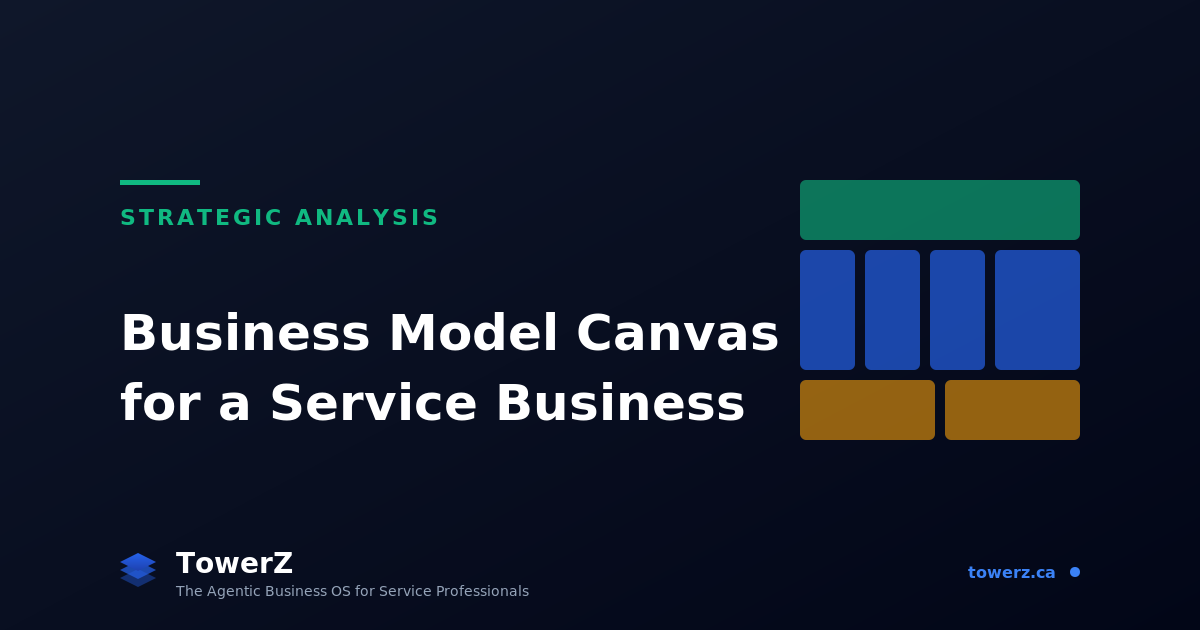
Business Model Canvas for a Service Business: A Practical Guide With Real Examples
Most service business owners can describe their business in two sentences. "I cut hair. People pay me." That's not wrong. It's just not enough.
The moment you want to grow, hire a second person, raise prices, launch a new service, attract a partner, or get a loan, those two sentences stop working. You need to be able to explain how the business actually creates value, who it serves, what it costs to run, and how the parts connect.
That's what the Business Model Canvas does. On a single page.
It is not a strategy. It is not a plan. It is a map of how your business works today. Once you can see the map, you can change it on purpose instead of by accident.
What Is the Business Model Canvas?
The Business Model Canvas (BMC), created by Alexander Osterwalder, breaks any business down into 9 connected blocks:
- Customer Segments: Who you serve
- Value Propositions: What you offer them, and why it matters
- Channels: How you reach and deliver to them
- Customer Relationships: How you stay connected
- Revenue Streams: How you get paid
- Key Resources: What you need to operate
- Key Activities: What you actually do
- Key Partnerships: Who helps you deliver
- Cost Structure: What it costs to run
It works for any business. It is especially useful for service businesses because services are invisible, there is no inventory, no warehouse, no product photo. The BMC makes the invisible visible.
The 9 Blocks Applied to a Real Service Business
Let's use a concrete example throughout: Camille Coaching, a one-person career coaching business in Quebec City. Camille works with mid-career professionals in tech and finance, offers 1:1 coaching packages and group cohorts, and runs primarily online with a small office for premium clients.
1. Customer Segments: Who Are You Actually Serving?
This is the block most owners get wrong. "Everyone who wants coaching" is not a segment. "Mid-career tech professionals in Quebec earning $80K-$140K and considering a transition into product or leadership roles" is.
Real segments are narrow enough that you can describe a typical client in detail, their job, their stage of life, their main pain, and what they would type into Google at 11 PM when they are stuck.
For Camille, the segments are: tech mid-managers stuck below the director ceiling, finance professionals considering an exit into consulting, and recent immigrants with senior careers abroad trying to relaunch in Quebec.
Three segments. Each one specific. Each one with a different angle of need.
Ask yourself: If I had to describe my top three client types in one sentence each, what would I write?
2. Value Propositions: Why You, Not the Other Coach?
The value proposition is the precise reason a client picks you over a free YouTube channel, a LinkedIn coach in California, or doing nothing at all. "I help people grow" is not a value proposition. It's a hope.
A real value proposition combines a specific outcome, a specific way of getting there, and a specific person it works for.
For Camille: "In 90 days, I help mid-career tech professionals in Quebec land a director-level role at a salary 25-40% above their current, using a structured method built on 200+ coached transitions."
That sentence explains the outcome, the timeline, the proof, and the audience. It is hard to write. It is worth the hours.
Ask yourself: What would my best clients say I do for them, in their own words?
3. Channels: How Clients Find and Use You
Channels are how your value reaches the customer, discovery, sales, delivery, support, post-sale. For service businesses, channels are usually a mix.
For Camille: LinkedIn content (discovery), a referral network of past clients (sales), Zoom sessions (delivery), an in-house workspace and recorded session library (support), and a quarterly alumni cohort (post-sale).
The interesting question is not which channels you use. It is which channels generate which percentage of revenue. If 70% of new clients come from referrals and 5% come from LinkedIn, your time allocation should probably reflect that.
Ask yourself: Where did my last 10 clients actually come from? Where do I invest my time vs. where the clients come from?
4. Customer Relationships: How You Stay Connected
This block answers: do you have a relationship with the customer between purchases, or only during purchases?
For Camille: monthly check-ins with past clients (light personal relationship), an alumni Slack group (community), automated value-add emails (automated personal), and the option to extend into a longer-term coaching retainer (paid recurring).
The deeper the relationship, the higher the retention and referrals. For most service businesses, this block is the cheapest growth lever and the most ignored one.
Ask yourself: What happens between the day a client buys and the day they need me again?
5. Revenue Streams: How You Actually Get Paid
This is where service owners realise they have fewer revenue streams than they thought. Or more often, that they have one big stream and three tiny ones disguised as a "diversified" portfolio.
For Camille: 1:1 coaching packages (75% of revenue), group cohorts (20%), a paid course (3%), and corporate workshops (2%). One main stream, three exploratory ones.
Naming this honestly is what allows you to decide: do I double down on the main stream, or seriously invest in growing one of the small ones?
Ask yourself: If I split my revenue by stream, what's the actual percentage? Is one of them a real business and three of them hobbies?
6. Key Resources: What You Need to Operate
For service businesses, key resources are usually people, expertise, tools, and relationships, not buildings or inventory.
For Camille: her own expertise and credentials, the proprietary 90-day method, the alumni network, a CRM, video infrastructure, and the small office for premium sessions.
Naming resources is a way to see your single points of failure. If "Camille" is one of your key resources and you have no system that survives her absence, the business is more fragile than it looks.
Ask yourself: What resources do I depend on that I would have to replace if they disappeared tomorrow?
7. Key Activities: What You Actually Spend Time On
Key activities are not your job description. They are the things that, when done well, create the value. When done poorly, sink the business.
For Camille: coaching delivery (40% of time), content creation (20%), client acquisition and sales conversations (20%), method development (10%), and admin/operations (10%).
Compare this to where you actually spend time. The gap is your biggest leverage opportunity. Most owners spend 40% of their time on admin and 10% on delivery, and wonder why growth is slow.
Ask yourself: If I tracked every hour for a week, what would the breakdown actually be?
8. Key Partnerships: Who Helps You Deliver
No service business runs alone. Partnerships save costs, reduce risk, or unlock channels.
For Camille: a recruiter network that refers candidates, a corporate training agency that books her workshops, a co-working space that hosts in-person sessions, and an accountant who handles GST/QST and incorporation matters.
Partnerships also include the tools you rely on (booking software, payment processing, email platform). When a tool becomes mission-critical, it stops being a tool and starts being a partner, with the risks that come with that.
Ask yourself: Who would I have to call to keep the business running if I disappeared for two weeks?
9. Cost Structure: What It Actually Costs
Last block, but the one that decides whether the model works.
For Camille: tools and software (25%), office and travel (15%), marketing and content production (20%), professional development (10%), taxes and accounting (15%), and her own salary (the remainder).
This is also where you ask: is my model cost-driven (compete on price) or value-driven (clients pay for outcomes)? Camille is value-driven, premium pricing, low volume. A high-volume nail studio would be the opposite. Both can work. They demand different operational decisions.
Ask yourself: What is the floor of my monthly costs, and how many service hours do I need to clear it?
How the 9 Blocks Connect
The Business Model Canvas is not a list. It is a system. The interesting work is reading the connections.
If you change Customer Segments, your Value Proposition changes. If your Value Proposition changes, your Channels change. If your Channels change, your Cost Structure changes. You cannot tweak one block without considering the ripple effects.
That is why mapping the model is more valuable than describing the business. The map shows you which lever, when pulled, actually moves the others.
BMC vs SWOT vs Strategy: Where Does It Fit?
| Business Model Canvas | SWOT | Business Strategy | |
|---|---|---|---|
| Answers | How does my business work? | Where do I stand? | Where am I going? |
| Time view | Now | Now + near-future | Future |
| Output | A map of your current model | Quadrants of internal/external factors | Goals, KPIs, milestones, actions |
The healthy sequence: build your BMC to see the model, run your SWOT to find priorities, then build your business strategy to commit to next steps.
Generate Your Business Model Canvas in 60 Seconds with TowerZ
A manual BMC takes 2-4 hours to do well, research, structuring, writing each block. TowerZ generates a complete BMC directly from your business profile in under a minute. All nine blocks, each editable inline, each connected to the rest of your TowerZ workspace.
Because your BMC lives next to your PESTEL, SWOT, Competitors Analysis, and Business Strategy, the boards inform each other. A new value proposition added to your BMC surfaces in your strategy. A new customer segment shows up in your content suggestions.
The BMC is part of TowerZ's Business Analysis software, built specifically for service entrepreneurs who want clarity without consulting fees.
Ready to see how your business actually works?
Try TowerZ for free and generate your Business Model Canvas in under a minute.
Frequently Asked Questions about the BMC
Is the BMC useful for a one-person business? Yes, arguably more useful. Solo operators have fewer people to consult and a higher chance of being trapped inside the daily work. The BMC forces you to step out and see the system you are running.
How often should I revisit my BMC? Once a quarter for stable businesses. Once a month if you are pivoting or scaling. The BMC is a living document, not a one-time exercise.
Can the BMC replace a business plan? For early-stage decisions, yes. For bank financing or formal investment, no, but the BMC is an excellent starting point that makes the full plan dramatically easier to write.
What's the difference between the BMC and the Lean Canvas? The Lean Canvas is a variant of the BMC adapted for early-stage startups (replacing some blocks with "Problem" and "Unfair Advantage"). For an operating service business, the standard BMC is usually the better fit.
How is the BMC different from the APO Diagnostic™? The BMC is a snapshot of your model. The APO Diagnostic™ is an AI-scored check on how well you are executing the model across Analysis, Planning, and Operations. The BMC tells you what the engine looks like. The APO tells you whether the engine is running well.
TowerZ is built for service businesses that want to grow with intention. The Business Model Canvas, alongside SWOT, PESTEL, and Competitors Analysis, is part of the Business Analysis module we built so owners can see the system, not just the symptoms.

About Orléando Dassi
Chief Executive Officer & Co-Founder
Orléando leads product vision, business strategy, and the long-term direction behind Automathing Group Inc. and TowerZ. He combines 12+ years in IT with a bachelor's degree in software development, business launch (ASP) training, and an MBA in progress at Université de Sherbrooke.
Related articles
Business Diagnostic: 12 Questions to See What to Fix First
A practical business diagnostic with a scorecard, signal reading, and a worked example so you know what to fix first.
Vision, Mission, and Values: Examples That Actually Mean Something
A practical guide to writing a vision, mission, and core values your team can actually use, with real examples across different kinds of businesses and a 60-second AI generator inside TowerZ.
How to Do a Competitor Analysis (Step-by-Step)
A practical 7-step competitor analysis method. Generate yours in 60 seconds with TowerZ.