A Strategy Doesn't Have to Be Complex. It Only Needs These 5 Things.
Most service business owners avoid strategy because it feels overwhelming. Here's the minimal, honest framework that actually works: goals, KPIs, personas, activities, and milestones.
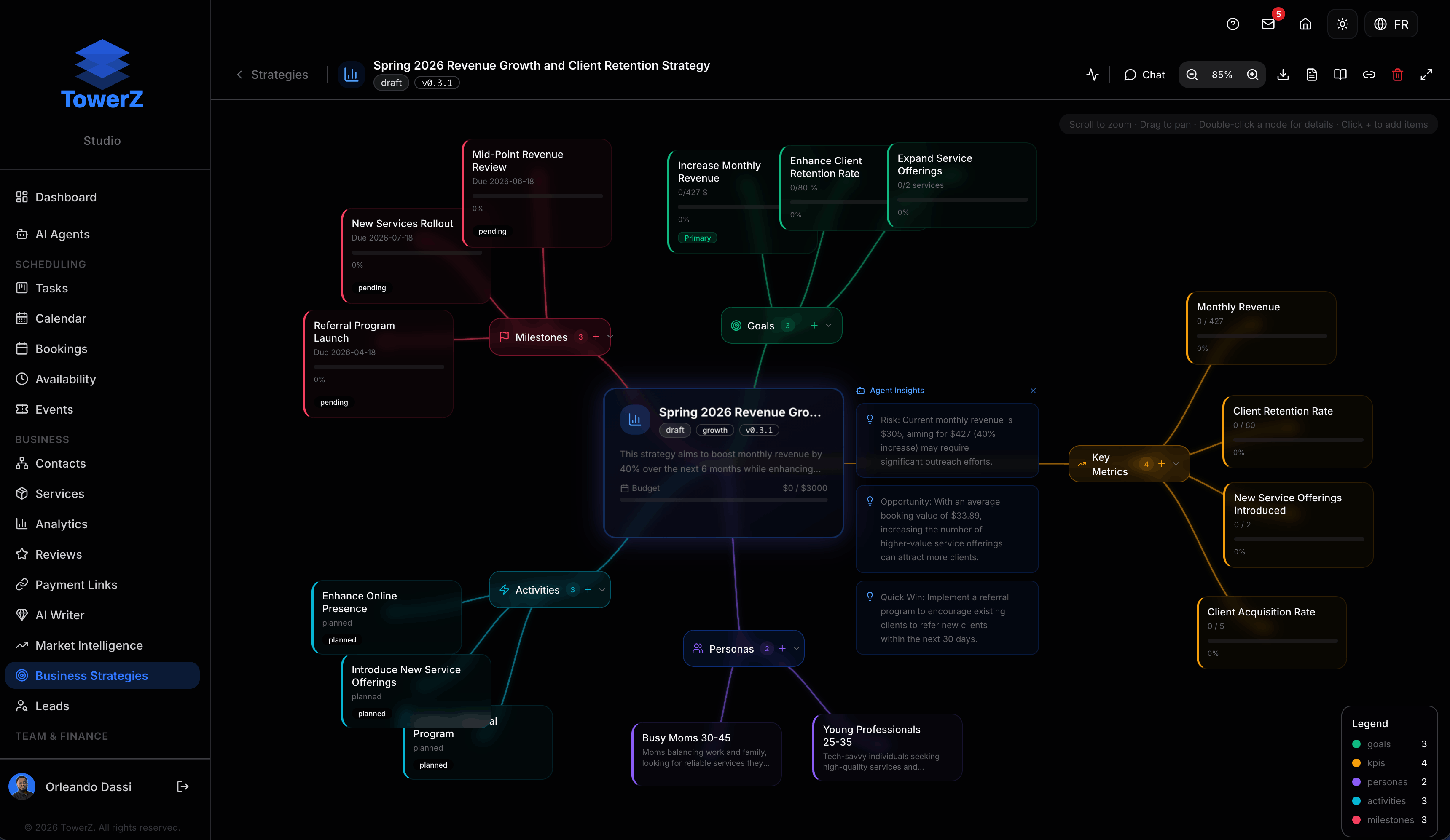
A Strategy Doesn't Have to Be Complex. It Only Needs These 5 Things.
The word strategy scares most service business owners.
It shouldn't.
Strategy has been hijacked by business schools, consulting firms, and startup culture. It's been turned into a thing you need a whiteboard, a retreat, and a $500 book to produce. Something you do once a year, forget immediately, and feel vaguely guilty about.
But underneath all that noise, a working strategy is actually simple. Not easy. Simple. There is a real difference between the two.
A strategy is just an honest answer to one question: How am I going to get from where I am now to where I want to be, and how will I know if it's working?
That's it.
And it only takes five things to answer it properly.
The 5 Elements of a Working Strategy
1. Goals: What Does Success Look Like?
Everything starts here. Not vague ambitions. Concrete, specific goals.
There's a version of this that doesn't work: "I want to grow my business." That's a wish. A goal is "I want to add 15 new recurring clients in the next 3 months" or "I want to reach $12,000 in monthly revenue before September."
The difference isn't semantics. Vague goals create vague plans. Specific goals make decisions obvious. When someone asks you to do something new, you can ask: does this get me to 15 new clients, or doesn't it?
For a salon owner managing a team of four stylists, a goal might be: increase monthly revenue per chair by 20% by August. For a wellness clinic running multiple practitioners, it might be: reach 300 completed appointments per month by Q3. For a large company launching a new business unit, it might be: acquire the first 50 paying clients and hit $100K in revenue within six months of launch.
All different. All specific. All workable.
2. KPIs: How Will You Know It's Working?
Goals tell you where you're going. KPIs tell you whether you're actually getting there.
KPI stands for Key Performance Indicator. The word "key" is doing a lot of work in that phrase. You need 3 to 5 numbers that tell you, at a glance, whether your business is moving in the right direction this week. That's it.
A good KPI is measurable, not a vanity metric. "Number of Instagram followers" is vanity. "Number of new client bookings from Instagram this month" is a KPI.
For a fitness studio pursuing client growth: new trial class signups per week, conversion rate from trial to membership, and churn rate. Three numbers. They tell you everything.
If your KPIs are going up, your strategy is working. If they're flat or falling, something needs to change. That's the whole point.
3. Personas: Who Exactly Are You Trying to Reach?
Most business owners have a fuzzy mental image of their ideal client. Something like "women who care about wellness" or "busy professionals." That's too broad to be useful.
A persona is a sharp, specific description of the type of person you're trying to serve. Name, age range, situation, pain points, what they want, what holds them back.
Example: "Marisol, 34, works in healthcare, books hair appointments on her lunch break, hates spending more than 90 minutes in the chair, values punctuality above everything else, and refers her colleagues when she trusts a provider."
Now you can make real decisions. Should you offer a 60-minute express service? Yes, Marisol would book that immediately. Should you run a late-evening event? Probably not. She's already stretched thin.
Personas aren't fiction. They're a discipline of specificity. The more clearly you can see your client, the better every decision downstream becomes.
4. Activities: What Will You Actually Do?
This is where strategy meets execution, and where most plans fall apart.
Activities are the recurring, concrete actions you'll take to move toward your goals. Not one-time tasks. Not ideas. Actions you'll take consistently.
"Post on Instagram three times a week featuring client transformations" is an activity. "Send a follow-up message to every no-show client within 24 hours" is an activity. "Run a monthly referral promotion for existing clients" is an activity.
The key question for every activity is: does this directly serve one of my goals and speak to one of my personas? If you can't connect the dot, drop it. Busy-work is the enemy of strategy.
Two to five well-chosen activities, executed consistently, beat a dozen random efforts every time.
5. Milestones: How Will You Pace Yourself?
Goals have endpoints. Milestones are the checkpoints along the way.
They serve two purposes: they keep you honest, and they stop you from burning out waiting to declare victory.
If your goal is to reach $15,000 monthly revenue by December, a milestone might be: "By end of July, average weekly bookings reach 40." Another might be: "By end of September, at least 30% of revenue comes from repeat clients."
Milestones are phase gates. They tell you whether you're on track to hit your goal, or whether you need to adjust your plan now, before it's too late to course-correct.
They also give you moments to acknowledge progress. A business that never celebrates incremental wins builds up resentment and fatigue. Milestones create natural checkpoints for both accountability and recognition.
Why This Framework Works for Service Businesses
These five elements aren't theoretical. They're the minimal viable architecture of any working business strategy.
You don't need a SWOT analysis, a value chain diagram, a Porter's Five Forces map, or a balanced scorecard. Those tools have their place. For a service business trying to grow with intention, they're usually overkill that leads to analysis paralysis.
Goals → KPIs → Personas → Activities → Milestones. This is enough to build a real plan, communicate it to a team, and execute it with discipline.
One thing separates this from frameworks like OKRs, the Balanced Scorecard, or Porter's Five Forces: Personas sit inside the strategy, not in a separate marketing deck. Most established frameworks treat who you're serving as a downstream concern, something for sales and content teams to figure out later. Here, the people you're building for are defined before you choose your activities, because your customer determines your work. That's not a UX decision. That's a strategic one.
What breaks the framework is not complexity. It's vagueness. The moment you let any of the five elements become fuzzy, the whole thing starts to drift.
The Honest Part Nobody Tells You
You won't get it perfect the first time. You'll set a goal that turns out to be the wrong goal. You'll pick KPIs that don't actually reflect what matters. You'll build activities that feel useful but don't move the needle.
That's normal. That's not failure.
Strategy isn't a document you write once and execute blindly. It's a living system you update as you learn. The point of the framework isn't to be right from day one. It's to give you enough structure to make progress, gather information, and adjust.
A rough strategy executed consistently beats a perfect strategy that lives in a drawer.
What This Looks Like in Practice
Let's say you run a wellness studio with three practitioners and you want to grow. Here's what the five elements might look like:
Goal: Add 20 new monthly memberships and hit $18,000 in recurring revenue by Q4.
KPIs: New trial bookings per week / Trial-to-membership conversion rate / Revenue per practitioner per month
Persona: "Camila, 34, operations manager at a mid-size firm, looking for a consistent wellness routine she can fit around her schedule and refer to her team."
Activities: Run two free community classes per month led by rotating practitioners / Launch a corporate wellness partnership with two local employers per quarter / Follow up with every trial client within 48 hours via text
Milestones: 10 new memberships by end of August / $14,000 recurring revenue by September / 20 new memberships and first corporate partnership signed by October
That's a real strategy. It took five minutes to sketch. It will take discipline to execute. And it's infinitely better than waking up every Monday hoping things grow.
TowerZ Builds This for You in Seconds
Sketching a strategy like the one above is possible on your own. Doing it well takes significantly longer: grounding the KPIs in your actual revenue, calibrating milestones against your real booking data, generating personas that reflect your actual client base.
That's what the TowerZ Strategy Canvas does. You describe your objective in plain language. The AI agent interprets the business data you authorize, pressure-tests targets against your actual numbers, and prepares a strategy scaffold for review: goals, KPIs, personas, activities, and milestones. You decide what becomes part of the plan.
You can edit every element. The canvas is yours to reshape. But you start with something concrete rather than a blank page.
Ready to build your first strategy?
Open the Strategy Canvas in TowerZ and generate yours now. It works best when you tell it something specific: a revenue target, a service you want to launch, or a problem you want to solve.
Once your strategy is live, two other TowerZ tools make sure it stays that way.
Focus helps you and your team prioritize what actually matters each day. Instead of reacting to whatever feels urgent, you work on the tasks most likely to move the needle toward your goals.
The APO Diagnostic gives you a real-time picture of where your business stands across Analysis, Planning, and Operations. It tells you whether you're on track, and exactly where to intervene before small gaps turn into expensive problems.
Strategy is where you decide the direction. Focus and the Diagnostic are how you stay on it.
Frequently Asked Questions about Business Strategy
Do I need to be a strategic planner to use this framework? No. These five elements are designed to be accessible to any business owner, regardless of background. The language is plain. The logic is practical. If you can describe what you want and who you're trying to reach, you can build a strategy.
How long should a strategy last? For most service businesses, a 3-to-6 month horizon is ideal. Short enough to stay relevant. Long enough to see results. Beyond 6 months, the assumptions tend to drift.
What if my goals change halfway through? That's expected, not a failure. Revise the goals, update the KPIs, adjust the activities. A strategy is a living document, not a contract.
Can I have more than one strategy at a time? Yes, but be careful. Most businesses can realistically pursue one primary growth initiative at a time. Two can work if they're genuinely independent. Three usually means none of them get the focus they need.
TowerZ is built for service businesses that are serious about growing with intention. The Strategy Canvas is one of the tools we've developed so that building a real plan stops feeling like something only big companies can do.

About Orléando Dassi
Chief Executive Officer & Co-Founder
Orléando leads product vision, business strategy, and the long-term direction behind Automathing Group Inc. and TowerZ. He combines 12+ years in IT with a bachelor's degree in software development, business launch (ASP) training, and an MBA in progress at Université de Sherbrooke.
Related articles
Business Diagnostic: 12 Questions to See What to Fix First
A practical business diagnostic with a scorecard, signal reading, and a worked example so you know what to fix first.
Vision, Mission, and Values: Examples That Actually Mean Something
A practical guide to writing a vision, mission, and core values your team can actually use, with real examples across different kinds of businesses and a 60-second AI generator inside TowerZ.
How to Do a Competitor Analysis (Step-by-Step)
A practical 7-step competitor analysis method. Generate yours in 60 seconds with TowerZ.