12-Month Strategic Roadmap for a Service Business
A practical 12-month roadmap method for service entrepreneurs: quarterly goals, monthly milestones, weekly execution. Live canvas in TowerZ.
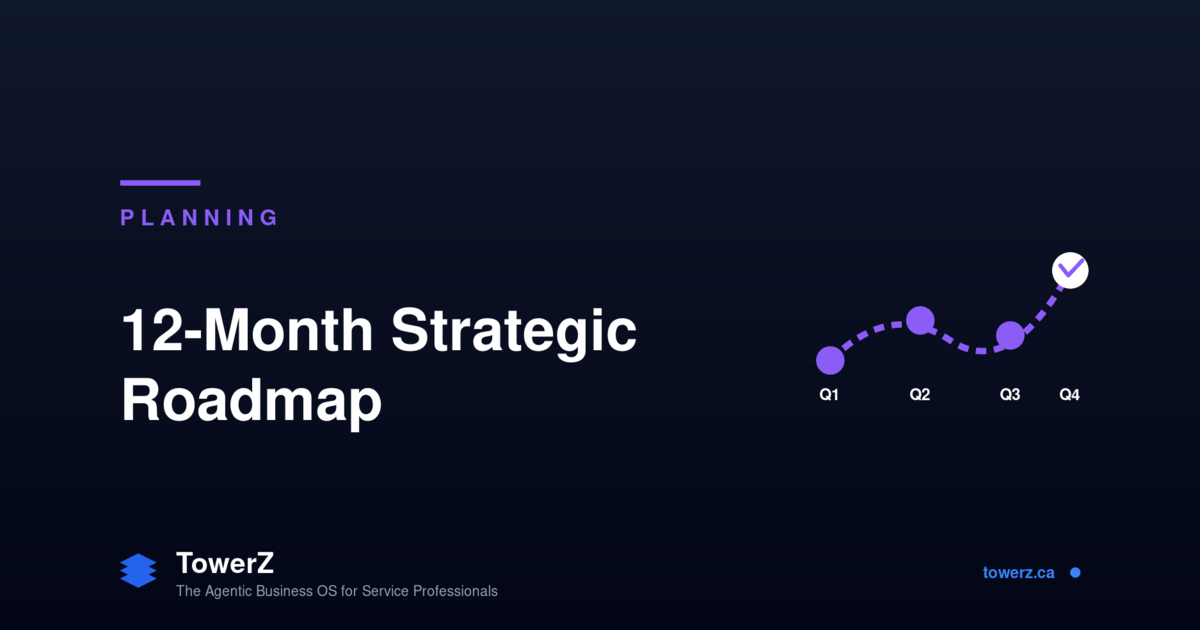
12-Month Strategic Roadmap for a Service Business: How to Build One That Ships
Most 12-month plans are written in January and forgotten by March. The reason is rarely lack of ambition. It is that the plan was built as a document, not as a system.
A plan that actually ships shares three qualities: it fits on one page, it breaks into quarterly milestones that anyone can see, and it produces one clear action every week. Anything more elaborate is a project. Anything less is a wish.
Here is a working roadmap method for service businesses, built to survive real weeks.
What a Roadmap Is (and Isn't)
A strategic plan is not a to-do list. It is not a strategy. It is not a project plan.
A strategic plan is the visible sequence of what you are going to build, launch, hire, and change over the next 12 months, ordered by priority, grouped into quarters, and tied to a small number of measurable outcomes.
The strategy answers where are we going and why. It answers what will we ship this quarter to get closer.
For a service business, that distinction is what separates a plan from a system that actually moves.
The 4 Building Blocks of a Working Plan
1. A Small Number of North-Star Outcomes
Start with 2 to 4 outcomes for the year. Not activities. Outcomes.
- "$300K annual revenue by December" (not "grow revenue")
- "60 percent client retention rate" (not "improve retention")
- "3 team members on payroll" (not "hire people")
- "Second location signed" (not "expand")
Each outcome is a number and a deadline. Everything on the plan traces back to at least one of these.
2. Quarterly Themes
Each quarter has one dominant theme. Not four. One.
Example for a coaching practice:
- Q1: Nail retention (fix the leaks first)
- Q2: Content engine (create the pipeline)
- Q3: First hire (deliver more without burning out)
- Q4: Prep for next year (systems, second product line)
A theme is not exclusive. Other work still happens. But when there is a conflict, the theme wins. This is what keeps you from spreading thin.
3. Monthly Milestones
Under each quarterly theme, list 2 to 4 monthly milestones. Each is a shippable outcome, not a task.
- "Deposit-required booking system live" (not "research booking software")
- "First 30-day drip email launched to lapsed clients" (not "work on retention")
- "Interviewed 6 candidates, hired 1" (not "start hiring process")
Milestones have a done state. If you can't tell whether it is done, it isn't a milestone.
4. Weekly Actions
Every Monday, look at the current milestone and pick 1 to 3 actions to close it. Not 12. One to three.
This is the layer where plans meet reality. If you can't identify a weekly action toward the current milestone, the milestone is too vague or too big.
A Real Roadmap Example (Solo Consultant, Year 2)
Let's ground this with a concrete example. Isabelle runs a solo strategy consulting practice, revenue $95K in year one, target $180K in year two.
North-star outcomes:
- Revenue $180K
- 12 active retainer clients (vs. 6 today)
- 40 percent revenue from productized service (vs. 100 percent from custom projects)
Q1 theme: productize the core offer.
- Month 1: Publish 3-tier productized service page
- Month 2: Launch signature 90-day program with 3 pilot clients
- Month 3: Refine pricing based on pilot feedback
Q2 theme: build the acquisition engine.
- Month 4: Launch LinkedIn content pillar (2 posts weekly)
- Month 5: Guest podcast strategy (5 shows confirmed)
- Month 6: First case study published from pilot cohort
Q3 theme: scale delivery capacity.
- Month 7: Hire virtual assistant (10 hours/week)
- Month 8: Systematize onboarding and monthly delivery
- Month 9: Reach 10 active retainer clients
Q4 theme: prep for year 3.
- Month 10: Launch second productized service
- Month 11: Set year-3 strategy with retreat
- Month 12: Publish annual review, refresh roadmap
Notice the shape. Each quarter has one theme, 2 to 3 milestones per month, and every milestone can be described in one sentence.
The 3 Rules That Keep Roadmaps Alive
Rule 1: One page. Physical or digital. Visible. If you have to open a folder to find your roadmap, you will forget it exists. Print it, pin it, embed it in your dashboard. Treat it like your kitchen calendar, not your archived documents.
Rule 2: Monthly review, non-negotiable. Last Friday of the month, 30 minutes. What shipped? What slipped? What changed? Adjust next month's milestones, keep the quarterly theme fixed.
Rule 3: Quarterly retro plus reset. End of each quarter, 90 minutes. Look at outcomes vs. plan. Retire what didn't work. Update the next quarter based on what you actually learned. Do not treat the roadmap as sacred, treat it as informed.
Common Mistakes
- Plan as marketing. Written to impress a stakeholder, not to guide the week.
- Too many outcomes. More than 4 north-stars and none of them get real attention.
- Milestones that aren't shippable. "Improve client experience" is not a milestone. "Launch new intake form in booking flow" is.
- No time for the unplanned. A roadmap that assumes 100 percent capacity ignores that half of what actually happens is unplanned. Leave 20 to 30 percent of your capacity for reality.
- Never referring to it after Q1. The most common failure. The roadmap becomes decoration.
Roadmap and the Business Strategy Canvas
A roadmap is the what and when. A business strategy is the why underneath. Every milestone should trace back to a strategic goal, a persona, or a KPI you are trying to move.
TowerZ's Business Strategy canvas lets you connect them: your strategy defines the goals, personas, KPIs, and activities. The roadmap sequences the activities into quarters and months. The two views stay linked automatically.
Build Your Roadmap in TowerZ
Most planning tools are project management tools bent into shape. Great for teams of 20, overkill for a service business.
TowerZ's roadmap tool is built for service entrepreneurs. Interactive canvas, quarterly grouping, milestone tracking connected to your KPIs and business strategy. When you complete a milestone, it updates your dashboard. When you shift a quarter, your strategy canvas reflects it. It is not a static file, it is a live view of where the business is heading.
The roadmap sits inside the Planning pillar, alongside the Business Strategy canvas, AI Writer, Smart Visual Generator, and the Agentic Platform.
Ready to build a roadmap you will actually ship against?
Try TowerZ for free and generate your 12-month roadmap in under an hour.
Frequently Asked Questions
How detailed should quarterly milestones be? 2 to 4 per month, each describable in one sentence, each with a clear done state. More detail than that turns into project management, which is a different tool.
What if reality forces me to change the roadmap? Change it. Monthly if needed. A living roadmap is more valuable than a beautiful abandoned one. The quarterly theme should stay stable, milestones can shift.
Can multiple people work on the same roadmap? Yes. In TowerZ, each milestone can be assigned, and the shared view is the single source of truth. But keep the outcome list small, no matter how large the team.
How is a roadmap different from a business plan? The plan is the strategic document. The roadmap is what you actually ship this year to move the plan forward.
Should the roadmap be public? For solo operators, private is fine. For teams, visible to the whole team is better. Client-facing? Never. That is a marketing document.
TowerZ is built for service businesses that want to grow with intention. The roadmap, the Business Strategy canvas, and the KPI dashboard together turn ambition into shipped work.

About Orléando Dassi
Chief Executive Officer & Co-Founder
Orléando leads product vision, business strategy, and the long-term direction behind Automathing Group Inc. and TowerZ. He combines 12+ years in IT with a bachelor's degree in software development, business launch (ASP) training, and an MBA in progress at Université de Sherbrooke.
Related articles
Business Diagnostic: 12 Questions to See What to Fix First
A practical business diagnostic with a scorecard, signal reading, and a worked example so you know what to fix first.
Why Your Marketing Problem Is Actually an Operations Problem
A simple framework to separate a real marketing problem from an operations leak caused by follow-up, no-shows, retention, capacity, or pricing.
Vision, Mission, and Values: Examples That Actually Mean Something
A practical guide to writing a vision, mission, and core values your team can actually use, with real examples across different kinds of businesses and a 60-second AI generator inside TowerZ.